Roofing contractors lose more business to timing than to competition. A homeowner whose roof is damaged in April isn’t searching Google in February—they’re calling whoever shows up in their mailbox when the storm rolls through. That’s the fundamental advantage of roofer direct mail: you can be in front of the right household at exactly the right moment, with a physical piece they hold in their hands rather than a banner ad they scroll past.
In 2026, digital ad costs for roofing keywords remain brutally expensive—often $40–$80 per click in competitive markets. Direct mail, by contrast, typically runs $0.50–$1.50 per household all-in, and response rates on well-targeted roofing campaigns typically land between 1% and 3%. Do the math on a 2,000-piece EDDM saturation drop: even a 1% response rate returns 20 inbound leads for a product where one closed job can be worth $8,000–$20,000.
This guide breaks down exactly how roofing contractors can build a measurable, repeatable local pipeline using direct mail—without wasting money on untargeted lists or poorly timed drops.
Why Direct Mail Works Especially Well for Roofers
Roofing is hyper-local by nature. Your crews work within driving distance. Your reputation spreads street by street. And your best prospects are often right next door to your most recent job—homeowners who just watched you replace their neighbor’s roof and are suddenly very aware of their own aging shingles.
According to the USPS Delivers research program, 57% of people say direct mail makes them feel more valued as a customer compared to digital communications. For a high-ticket, trust-dependent purchase like a roof replacement, that tactile connection matters.
Direct mail also doesn’t require a homeowner to already be in buying mode. A well-designed contractor postcard plants a seed. Six months later, when a hailstorm hits or their ceiling starts showing water stains, your brand is what they remember.
Two Core Strategies for Roofing Direct Mail
1. EDDM Saturation Campaigns
Every Door Direct Mail (EDDM) is the workhorse for roofing contractors who want to dominate a neighborhood without purchasing a custom list. You select specific USPS carrier routes—by zip code, neighborhood, or even street-by-street—and your mailer goes to every residential address on that route. No list required. No minimum order headaches.
Current EDDM retail rates run approximately $0.20–$0.25 per piece, making it one of the most cost-efficient ways to saturate a defined geography. Combined with printing, a standard 6.5″×11″ or 6.5″×12″ postcard campaign typically comes in around $0.50–$0.80 per household all-in when you work with a full-service partner like Shop Direct Mail, who handles design, printing, and mailing under one roof.
When to use EDDM saturation:
- After a hailstorm or wind event—target the specific zip codes affected
- Spring and fall seasonal tune-up or inspection promotions
- Brand awareness in new service territories you’re expanding into
- After completing a high-profile job in a neighborhood (circle prospecting)
Learn more about how EDDM works for contractors at our Every Door Direct Mail service page.
2. Targeted List Campaigns
While EDDM blankets an area, a purchased list lets you get surgical. For roofing, the most productive list filters typically include:
- Home age: Homes built 15–25+ years ago with roofs likely approaching end of life
- Homeownership status: Owner-occupied only—skip renters who can’t authorize a replacement
- Home value range: Middle-to-upper tier homes where owners invest in proper repairs rather than the cheapest patch
- Recent insurance claims: Where available, homeowners who’ve filed recent hail or wind claims
A targeted list campaign typically costs more per piece to execute but often produces higher response rates because you’re reaching households with a genuine, near-term need. At Shop Direct Mail, list acquisition is part of our full-service offering—you don’t need a separate data vendor to get started.
Storm Chasing: The Roofer’s Secret Weapon
When a hailstorm or major wind event hits a specific zip code, the window of opportunity is real but narrow. Homeowners are actively thinking about roof damage—they’re seeing neighbors file claims, they’re checking their own ceilings. If you can get a mailer in front of them within 7–14 days of the event, response rates climb significantly above baseline.
This is where a full-service direct mail partner earns its value. A storm-chasing campaign requires:
- Rapid identification of affected carrier routes or zip codes
- Quick design turnaround with storm-specific messaging (“Was your roof affected by the April 18th storm?”)
- Fast print and mail execution—ideally within 5–10 business days of the event
A roofing contractor who mails within two weeks of a storm often faces far less competition than one who relies solely on door-to-door canvassing or waits for organic search traffic to build. Speed is the differentiator.
Designing Contractor Postcards That Actually Get a Response
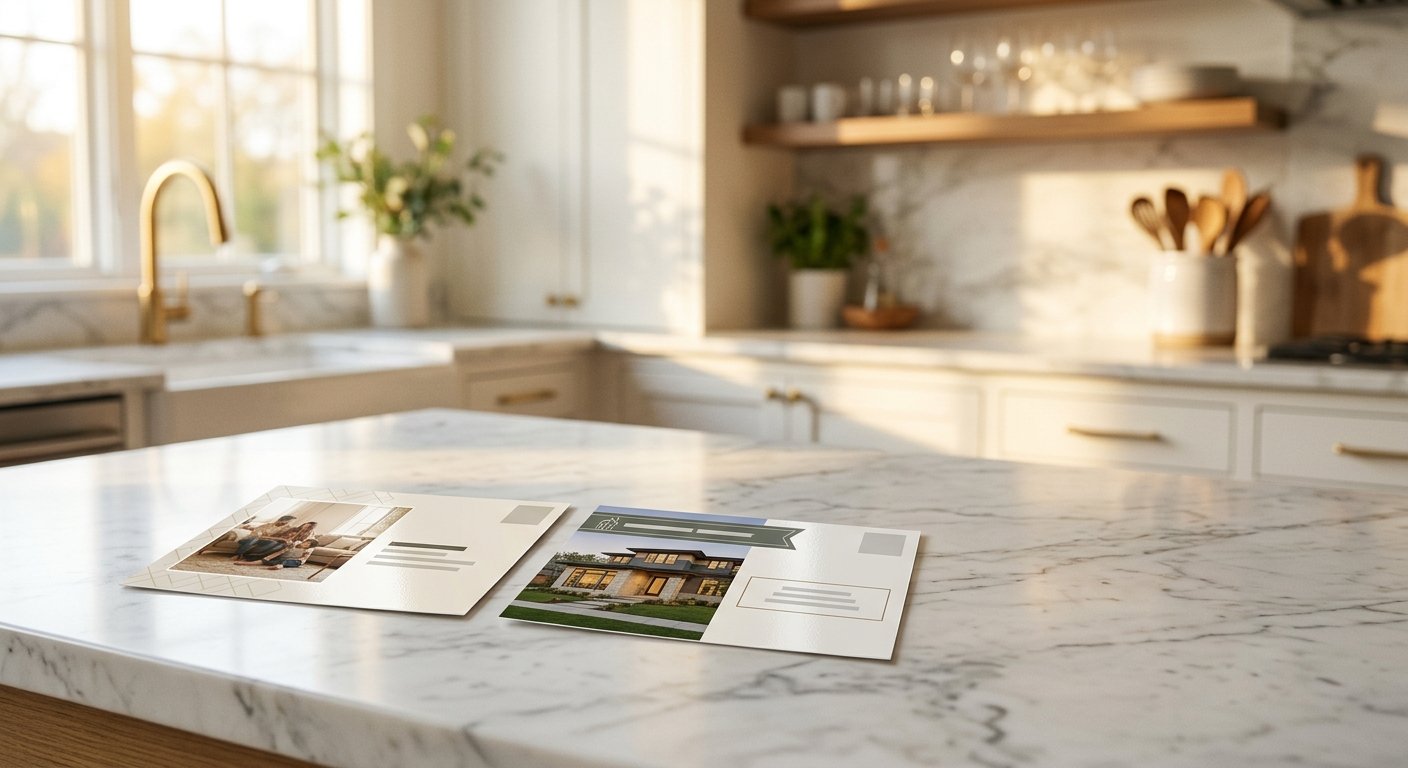
The best roofing postcard isn’t the prettiest one—it’s the one that communicates a clear reason to call in under five seconds. Homeowners sort mail over a recycling bin. You have one moment.
High-converting roofing postcard elements:
- Headline that speaks to a specific problem or event: “Storm Damage in [Neighborhood]? Free Inspection—No Obligation.”
- Social proof: A customer photo, star rating, or one-line testimonial from a nearby street builds instant credibility
- Clear offer: Free inspection, financing available, or a maintenance special—something low-risk that gets the phone ringing
- Tracking mechanism: A unique call-tracking number or QR code so you know exactly which campaign generated each lead
- License and insurance callout: In roofing especially, prospects want to know you’re legitimate before they ever call
Avoid cluttering your postcard with a full menu of services. Roofing, gutters, siding, windows—pick one message per mailer. Campaigns that try to sell everything at once typically convert less effectively than focused, problem-specific pieces.
Tracking ROI on Roofing Direct Mail Campaigns
One of the most common objections we hear from contractors is: “How do I know if it’s working?” The answer is that direct mail is more trackable than most contractors realize.
Practical tracking methods:
- Call tracking numbers: Assign a unique phone number to each campaign. Every call from that number is attributed directly to that mailer.
- QR codes: Link to a campaign-specific landing page or scheduling form. Track scans and conversions separately from your normal web traffic.
- Promo codes: “Mention code ROOF26 for a free gutter inspection with any roof estimate” makes attribution simple.
- Ask every inbound caller: “How did you hear about us?” is still a reliable data point—train your front desk or answering service to capture it.
For EDDM campaigns specifically, USPS provides delivery confirmation receipts. You’ll know exactly when your pieces were delivered, which helps you correlate call volume spikes to mail delivery windows.
According to the Data & Marketing Association, direct mail consistently outperforms digital channels in response rate for local service businesses, with household response rates often 5–9× higher than email. That gap matters when you’re measuring cost per acquired customer.
Building a Year-Round Roofing Pipeline
The contractors who get the most out of direct mail treat it as a consistent channel, not a one-time test. A single mailer rarely produces dramatic results. A quarterly campaign schedule—timed around seasonal demand peaks and local weather patterns—builds brand familiarity that compounds over time.
A sample annual mailing calendar for a roofing contractor:
- February/March: Spring inspection promo—get on the schedule before storm season
- May/June: Post-storm saturation if applicable; otherwise, summer reroof promotion with financing message
- August/September: Fall preparation—”Don’t go into winter with a questionable roof”
- October/November: Year-end urgency—insurance claim deadlines, pre-winter installs
Running campaigns consistently to the same carrier routes also builds recognition. By the third or fourth mailer, homeowners start to know your name before they ever need a roofer. When their moment comes, you’re already the obvious call.
Frequently Asked Questions
How much does a roofing direct mail campaign cost?
Costs vary depending on quantity, format, and targeting. EDDM saturation campaigns typically run approximately $0.50–$0.80 per household all-in (design, print, and postage). Targeted list campaigns may run slightly higher due to list acquisition costs. On a 2,000-piece campaign, total investment often ranges from $1,000–$1,800 depending on specifications—a fraction of what you’d spend on equivalent pay-per-click roofing ads.
What size postcard works best for roofing EDDM?
The most common and effective EDDM sizes for roofing contractors are 6.5″×11″ and 6.5″×12″. These formats are large enough to stand out in a mail stack but still qualify for EDDM retail postage rates. Going larger increases visual impact; oversized pieces typically see higher open and retention rates in consumer research.
How soon after a storm should I mail?
Aim for within 7–14 days of a significant hail or wind event in your target zip codes. Homeowners are most receptive during the first two to three weeks post-storm, when damage is fresh and they’re actively seeking contractors. Storm-chasing campaigns that deploy within this window often outperform baseline campaigns significantly in response rate.
Can I target specific neighborhoods instead of blanketing a full zip code?
Yes. EDDM lets you select individual carrier routes, which are much smaller geographic segments than a full zip code. You can choose routes based on home age, estimated home value, or proximity to a completed job. Targeted list campaigns give you even more granular control—filtering by homeowner status, home age, and other demographic variables.
How do I track which leads came from my mailer?
Use a unique call-tracking number printed on every mailer, a QR code linked to a campaign-specific landing page, or a promo code your front desk captures at intake. These methods give you clear attribution so you can calculate cost per lead and cost per acquired job from each campaign.
Ready to Start Generating Roofing Leads?
Building a local roofing pipeline with direct mail isn’t complicated—but it does require the right timing, the right targeting, and creative that earns a second look. Shop Direct Mail handles every piece of that process, from carrier route selection and list acquisition to design, printing, and mailing nationwide.
If you’re ready to put your next storm-chasing campaign or seasonal promotion in front of the right homeowners, explore our EDDM services for contractors or get started with a full direct mail strategy built around your service area and revenue goals.