Most real estate business cards get glanced at for three seconds and dropped in a junk drawer—or worse, the trash. But the right card stays on a kitchen counter, gets passed to a friend, or sits in a wallet for months until that person is finally ready to buy or sell. That’s a lead that costs you pennies and converts on its own schedule.
The difference between a forgettable card and a client-winning one isn’t luck. It’s intentional design, quality materials, and a clear message that makes the person holding it feel like they’d be making a mistake not to call you. Here’s how to get there.
Why Business Cards Still Matter in Real Estate
Before we get into design specifics, let’s address the obvious question: in 2026, with digital everything, do business cards actually move the needle for real estate agents?
Yes—and the data backs it up. According to the National Association of Realtors, personal referrals and repeat business account for a significant portion of real estate transactions. Business cards are the physical handshake that punctuates those in-person moments—open houses, community events, neighborhood canvassing—where a phone screen feels cold and a card feels professional.
Real estate print marketing isn’t competing with digital; it’s completing it. When you hand someone a well-designed card after a conversation, you’re leaving a tangible artifact of that interaction. Digital ads disappear when the budget stops. A quality card doesn’t.
The Anatomy of a High-Performing Realtor Business Card
Think of your business card as a micro-billboard. You have roughly three inches of horizontal space and about two seconds of attention. Every element needs to earn its place.
Front of the Card: First Impressions Close Deals
- Professional headshot: Real estate is a relationship business. People work with people they trust, and a clear, approachable photo accelerates that trust. Skip the glamour shot—use a clean, well-lit portrait that matches how you look in person.
- Your name and designation: Full name, license designation (REALTOR®, ABR, CRS, etc.), and team or brokerage affiliation. Keep hierarchy clear—your name should be the largest text element.
- Your value proposition: One short line. “Selling Homes Faster in [Market Area]” or “Buyer’s Agent Specializing in First-Time Homeowners.” Specific beats generic every time.
- Brand cohesion: Your card should match your postcards, signs, and social media. Consistent color palette and logo use signal professionalism and help people recognize you across touchpoints.
Back of the Card: Make It Work Harder
Most agents leave the back blank or slap a logo on it. That’s wasted real estate—literally. Consider these high-value uses:
- A QR code linking to your listing portal or a free home valuation tool
- A short testimonial: “We sold in 9 days above asking price. — The Martinez Family”
- Your service area neighborhoods or a map graphic
- A checklist (“Thinking of Selling? Here Are 3 Things to Do First”) that gives immediate value
The back of your card is a second chance to start a conversation. Use it.
Print Specs That Signal Professionalism
Cheap printing communicates cheap service. In a high-stakes transaction like buying or selling a home, nobody wants to work with someone who cuts corners—and your card is the first data point they have.
Standard vs. Premium Stock
The standard business card size (3.5″ × 2″) still dominates, but the weight and finish make all the difference. For real estate business card design, we recommend:
- 16pt or 18pt card stock: Noticeably heavier than standard 14pt. When someone takes your card, the weight alone signals quality.
- Soft-touch matte lamination: Creates a velvety feel that’s incredibly memorable and harder to put down. It also makes your headshot pop with contrast.
- Spot UV coating: Adds a glossy accent layer to specific elements (your logo, name, or photo border) against a matte background. The tactile contrast is striking.
- Rounded corners: A small detail that signals modern, intentional design and makes the card stand out in a stack.
When to Consider Non-Standard Formats
Some high-producing agents use square cards (2.5″ × 2.5″) or mini cards as a second leave-behind. Luxury market agents sometimes invest in metal or thick cotton-paper cards. These are conversation starters, but they come at a higher cost per unit—evaluate whether the format fits your market positioning before going premium on the format alone.
Design Mistakes That Kill Conversions
Even a beautiful print job can’t save a card with these common design errors:
- Cluttered layout: Three phone numbers, two email addresses, a fax number, and four social handles. Pick the two or three contact methods you actually use and remove the rest.
- Font overload: Two fonts maximum. One for your name/headline, one for body details.
- Low-resolution photos or logos: Your headshot should be at least 300 DPI at print size. Pixelated photos look unprofessional in print even when they look fine on a screen.
- Brokerage branding that overshadows yours: Your brokerage’s brand should support your identity, not replace it. Clients hire you, not the brokerage logo.
- No clear call to action: What do you want them to do? Call you, scan a code, visit your site? Make it obvious.
How to Distribute Cards Strategically
Printing great cards and leaving them in your desk drawer accomplishes nothing. Distribution strategy matters as much as design.
The best agents pair business cards with a broader real estate marketing materials system. Cards go to:
- Every open house visitor (attach to a follow-up flyer or property sheet)
- New neighbors during just-listed canvassing walks
- Service providers in your area—hair salons, coffee shops, gyms—who interact with community members daily
- Every transaction closing (leave 10 cards with the buyers or sellers to share with friends)
- Local business networking events and community boards
Think of your card as the anchor of an in-person touchpoint, not a standalone campaign. When paired with a consistent postcard farming strategy—where your name is already showing up in mailboxes every month—handing someone your card accelerates recognition and trust significantly. Learn more about how that works in our real estate marketing resources.
Integrating Cards Into Your Direct Mail Campaigns
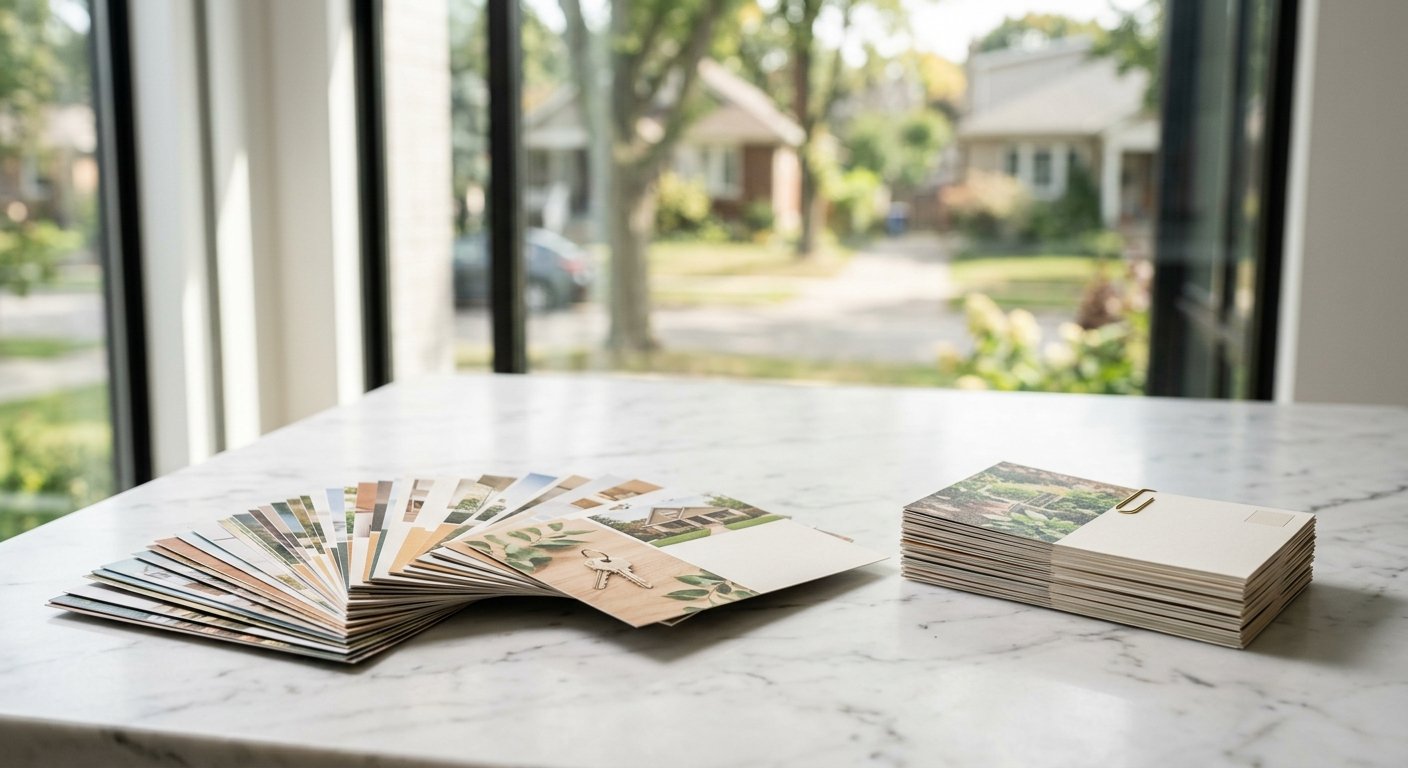
Here’s a tactic that separates top producers from average agents: include a business card insert inside a direct mail piece. When you send a just-listed or market update postcard to a farm neighborhood, add a card tucked into a letter format or affixed to a larger mailer.
This works because the postcard gets attention at the mailbox, and the business card travels with the homeowner wherever they go next. It’s a two-touch campaign in a single envelope.
According to USPS research on direct mail, physical mail has notably high open and retention rates compared to digital equivalents—making your card more likely to be seen and kept when it arrives with a well-designed piece rather than alone.
At Shop Direct Mail, we handle design, printing, list acquisition, and mailing under one roof—so pairing your business card print run with a postcard campaign is simpler than coordinating three separate vendors. See how our real estate postcards complement a strong card strategy.
Frequently Asked Questions
How many business cards should a real estate agent order at once?
Most active agents order between 500 and 1,000 cards per print run. If you’re in a high-touch market or do frequent open houses and events, 1,000 is a practical minimum. Ordering in volume typically reduces the per-card cost significantly and ensures you’re never caught without cards at a critical moment.
What information is essential on a realtor business card?
At minimum: your full name, brokerage or team name, phone number, email address, and a link or QR code to your listings or website. Your headshot and a short value statement are strongly recommended. License number requirements vary by state—check your local regulations to confirm what’s required on your card.
What’s the best finish for real estate business cards?
Soft-touch matte lamination is consistently popular for its premium feel and readability. Spot UV adds a memorable tactile element. Glossy finishes are a step above standard but can feel dated. Avoid uncoated stock unless you’re going for a very specific boutique aesthetic—it tends to look inexpensive in comparison.
Can I track ROI from business cards?
Yes, in several ways. Use a unique phone number or vanity URL on your card that you don’t use elsewhere. A QR code with UTM parameters tied to a landing page lets you track scans in Google Analytics. Ask new clients at intake how they found you—many will reference the card specifically. It’s not as precise as digital tracking, but it’s measurable.
Should my business card match my direct mail design?
Absolutely. Brand consistency across all real estate marketing materials—cards, postcards, door hangers, and yard signs—builds recognition over time. When a homeowner sees your postcard each month and then meets you at an open house, your card should feel like an extension of everything they’ve already seen. That visual familiarity reduces friction and accelerates trust.
The Bottom Line
A real estate business card isn’t a formality—it’s a marketing asset. When the design is sharp, the stock feels substantial, and the message is clear, a card can generate a referral months after the initial handoff. That’s one of the lowest cost-per-touch formats in your entire marketing toolkit.
If your current cards don’t reflect the quality of service you actually deliver, it’s time for a refresh. Shop Direct Mail’s design and print team works with real estate agents nationwide to produce cards that complement broader farming and prospecting campaigns—strategy, design, and production all coordinated from one place.
Ready to upgrade your real estate marketing materials? Explore our full suite of direct mail marketing services or contact our team to talk through a card and postcard package that fits your market goals.