

EDDM (Every Door Direct Mail) delivers to every address on a USPS carrier route — no list needed, lower postage, ideal for saturation coverage. Targeted mailing lists let you filter by demographics, homeownership, income, or transaction history to reach a specific audience. The right choice depends on whether your best prospect is “everyone nearby” or a defined person with a particular profile.
- EDDM costs roughly $0.20–$0.25 per piece with no list purchase — best for blanket neighborhood saturation.
- Targeted lists narrow your audience by income, homeownership status, age, or recent home purchase, reducing waste and improving relevance.
- Real estate agents typically need targeted lists for farming specific homeowner profiles; contractors often win with EDDM saturation by carrier route.
- Both methods are trackable — use unique phone numbers, QR codes, or promo codes to measure response.
- A hybrid approach (EDDM for awareness, targeted lists for follow-up) often outperforms either channel alone.
What Is EDDM and How Does It Work?
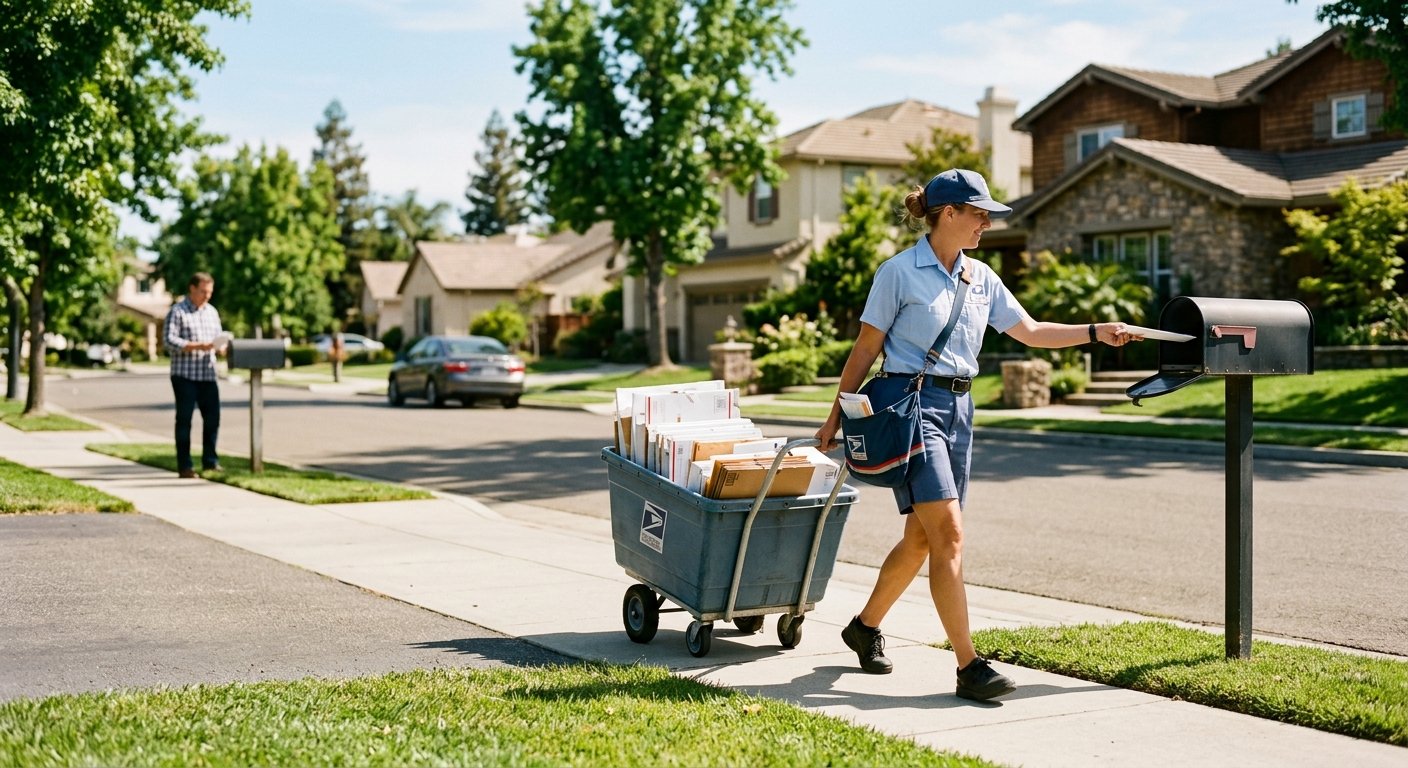
Every Door Direct Mail is a USPS program that lets businesses mail to every deliverable address on one or more carrier routes without purchasing a mailing list or printing individual names and addresses. You select routes on the USPS mapping tool, pay a flat retail postage rate (currently approximately $0.20–$0.25 per piece), print pieces that meet USPS size minimums — typically 6.25″×9″, 6.5″×11″, or 6.5″×12″ — and drop them at the post office serving those routes.
The trade-off is intentional: you trade demographic precision for lower cost and maximum coverage. For a roofing company blanketing a zip code after a hailstorm, or an HVAC company mailing a pre-summer tune-up offer to every household in a neighborhood, that trade is almost always worth it. Our full EDDM service handles route selection, artwork, printing, and drop-off so you’re not navigating USPS paperwork on your own.
The USPS EDDM mapping tool shows you household count, average household income, and residential vs. business mix by route — use this data before you commit to a route to make sure the demographics roughly match your offer.
What Are Targeted Mailing Lists?

A targeted mailing list is a curated dataset of specific people or households that match criteria you define. Common filters include homeownership status, length of residence, estimated home value, household income, age range, recent life events (new mover, new parent), and transaction history. Unlike EDDM, you’re only mailing to the prospects most likely to need your product or service — which means a smaller universe but a higher relevance score per piece.
List acquisition is one of the most underestimated steps in a direct mail campaign. A bad list wastes printing and postage on addresses that will never convert. A well-segmented list — say, homeowners who have lived in the same house for 10+ years and likely have aging HVAC systems, or absentee owners who might want to sell — dramatically improves your return per dollar spent.
At Shop Direct Mail, list acquisition is part of our full-service offering. We source, clean, and segment data so you’re not chasing outdated records from a discount list broker.
Head-to-Head: EDDM vs. Targeted Mail

| Factor | EDDM | Targeted Mailing List |
|---|---|---|
| Audience selection | Every address on a carrier route | Filtered by demographic or behavioral criteria |
| List cost | None — no list purchase | Varies by size and data depth |
| Postage rate | ~$0.20–$0.25/piece (retail) | Typically higher per piece |
| Personalization | Generic (no name/address on piece) | Full name, address, can vary messaging |
| Minimum quantity | 200 pieces per route | Usually 200–500 depending on mail class |
| Best for | Saturation, awareness, contractors | Farming, niche offers, high-value targets |
| Tracking | QR codes, promo codes, call tracking | Same, plus personalized URLs (PURLs) |
When EDDM Is the Right Call
EDDM excels when your ideal customer is geographically defined but demographically broad. Classic use cases:
- Contractors after a weather event: A roofer mailing to every home in three carrier routes after a hailstorm doesn’t need demographic filters — every homeowner on those streets is a potential customer.
- New business awareness: A gym, dental practice, or auto shop opening in a neighborhood wants every household within a few miles to know they exist.
- Seasonal promotions: An HVAC company running a fall furnace-check special benefits from mailing every address rather than filtering — the cost per additional household is low, and heating systems don’t sort themselves by income.
- EDDM saturation for real estate: An agent new to a farm area can introduce themselves affordably by blanketing carrier routes before narrowing their list for follow-up campaigns.
When your best prospect is “anyone with a roof on this block,” EDDM is almost always the more efficient first move.
When Targeted Lists Win
Targeted lists earn their cost when your offer is specific and your audience is narrow. The math shifts quickly once you factor in the waste of mailing irrelevant households.
- Real estate farming: An agent focused on a 500-home subdivision wants to mail homeowners specifically — not renters, not businesses. A targeted list filters to owner-occupied households and can even flag properties with long tenure (likely sellers in the next 24 months).
- Just-listed / just-sold circle prospecting: Sending real estate postcards to the 200 closest homeowners around a recent transaction is a targeted-list play, not EDDM.
- High-ticket contractor services: A kitchen remodeler targeting homeowners with estimated home values above a threshold and 7+ years of residence is using demographic filtering to protect a higher cost-per-piece investment.
- Financial and healthcare outreach: Mortgage refinance offers, Medicare supplement mailers, and wealth management prospecting all depend on income, age, and life-event triggers that EDDM simply can’t filter.
Cold targeted lists typically generate response rates in the 0.5%–2% range. Warm audiences — past customers, recent inquiries, high-relevance demographics — often outperform that. EDDM saturation campaigns run in a similar range, but the lower cost per piece means you can mail more households to hit the same lead volume at a comparable budget.
The Hybrid Approach Most Businesses Miss
Many of the most effective campaigns combine both methods in sequence. Here’s a pattern that works consistently for real estate agents and contractors alike:
Saturate with EDDM
Use EDDM carrier routes to introduce your brand to a full neighborhood at the lowest possible cost per impression. Build name recognition before you spend more per piece.
Follow up with a targeted list
Pull a filtered list from that same geography — homeowners only, specific home value range, or recent life event — and mail a higher-value, personalized piece to your top prospects.
Maintain consistent cadence
For real estate farming, plan a minimum 6-month mailing horizon. The National Association of Realtors consistently reports that sellers contact agents they’ve heard from multiple times — one mailer rarely moves the needle.
Track and refine
Use unique call-tracking numbers, QR codes, or promo codes on each campaign to separate EDDM response from targeted-list response. Double down on what converts.
How to Track Both Campaigns
One of the most common objections to direct mail is “I can’t tell if it’s working.” That’s a setup problem, not a channel problem. Both EDDM and targeted mail campaigns are fully trackable when you build measurement in from the start.
For EDDM, assign a unique phone number or QR code to each carrier route you mail. When calls or scans come in, you know which route generated them. For targeted mail, personalized URLs (PURLs) or offer codes let you tie response directly to the list segment that received them. USPS also provides delivery confirmation on EDDM drops so you know when pieces hit homes — useful for coordinating any follow-up digital touch.
The direct mail marketing team at Shop Direct Mail builds tracking into every campaign by default — not as an add-on, because an unmeasured campaign is a missed learning opportunity.
Don’t compare EDDM and targeted mail on response rate alone. EDDM’s lower cost per piece often means a lower cost per lead even at a similar response rate — always do the full unit economics before deciding which method is “better.”
Frequently Asked Questions
Can I use EDDM for real estate farming?
Yes, EDDM works well for initial real estate farming — especially when you’re introducing yourself to a new neighborhood and want to reach every household affordably. For ongoing farming with personalized messaging or filtering to homeowners only, a targeted list typically delivers better relevance and ROI over a 6+ month campaign horizon.
Is EDDM only for small businesses?
No. EDDM is available to any business through USPS and is used by both small local operators and large regional companies. The program is particularly cost-effective for local saturation regardless of business size.
How much does a targeted mailing list cost?
List costs vary based on the number of records, data depth, and the source. Rather than quoting a number that won’t age well, we build list acquisition into campaign planning so the cost is factored into your total per-piece budget from the start. The quality of the list matters far more than the cost of it.
What’s the minimum number of pieces for EDDM?
USPS requires a minimum of 200 pieces per carrier route for EDDM. Most routes contain 400–600 deliverable addresses, so a single-route campaign will typically land in the 400–600 piece range naturally.
How do I know which method is right for my business?
Start with this question: is your best customer defined by where they live, or who they are? If geography is the primary qualifier (contractors, local retail, new business awareness), EDDM is usually the efficient starting point. If your prospect has a specific profile — homeowner, income bracket, recent life event — a targeted list pays for itself through reduced waste.
Not sure which approach fits your campaign?
Tell us about your audience and goals — we’ll map out a campaign strategy, handle design, list acquisition, printing, and mailing end-to-end, so you’re not coordinating five vendors to send one postcard.

About Shop Direct Mail Marketing
Shop Direct Mail is a full-service direct mail marketing partner for real estate agents, contractors, and local service businesses nationwide. We provide end-to-end strategy, design, list acquisition, printing, and mailing services that help small and medium-sized businesses cut through digital clutter with tangible, measurable campaigns. Our focus is on ROI-driven tactics like real estate farming, EDDM saturation, just-listed/just-sold postcards, and neighborhood prospecting that generate leads and customers business owners can track. Visit shopdirectmail.com →