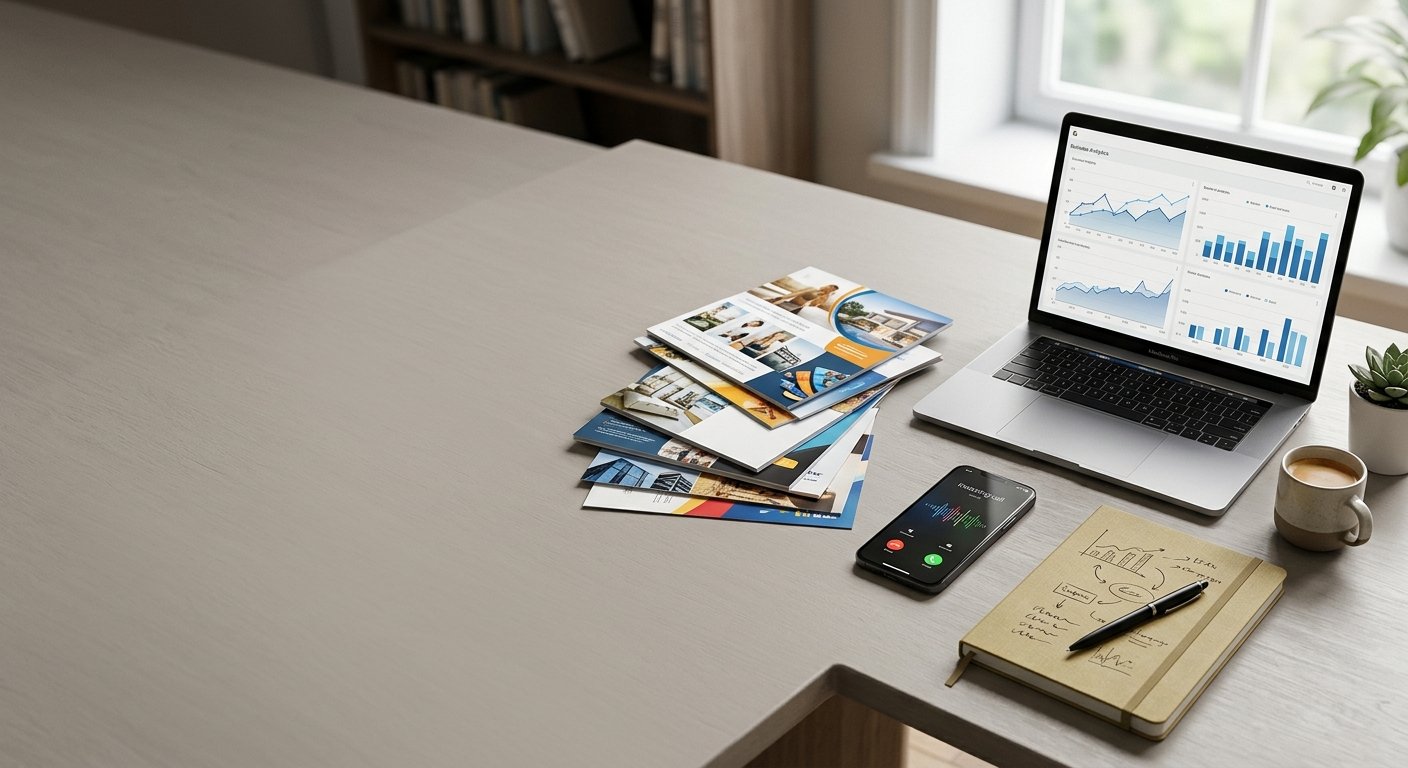

Use targeted mailing lists when you need to reach a specific demographic—homeowners by income, renters, recent movers, or businesses by type. Use Every Door Direct Mail (EDDM) when saturation across a geographic area matters more than audience filters. Most campaigns for real estate agents and contractors fall clearly into one category once you know the difference—and choosing wrong can cost you both time and money.
- EDDM saturates every address on a carrier route; EDDM Retail postage is currently $0.26 per piece (USPS)—ideal for neighborhood awareness and contractor service areas.
- Targeted mailing lists let you filter by homeownership, income, age, credit triggers, and more—ideal for real estate farming and specialty contractor campaigns.
- Response improves with sharper targeting and repeated mailings to the same homes—track every campaign to learn your own numbers.
- Neither method is universally superior—the right choice depends on your offer, audience, and budget.
- Full-service partners handle list acquisition, design, printing, and mailing in one place—reducing the coordination tax on busy business owners.
The Core Difference in One Sentence
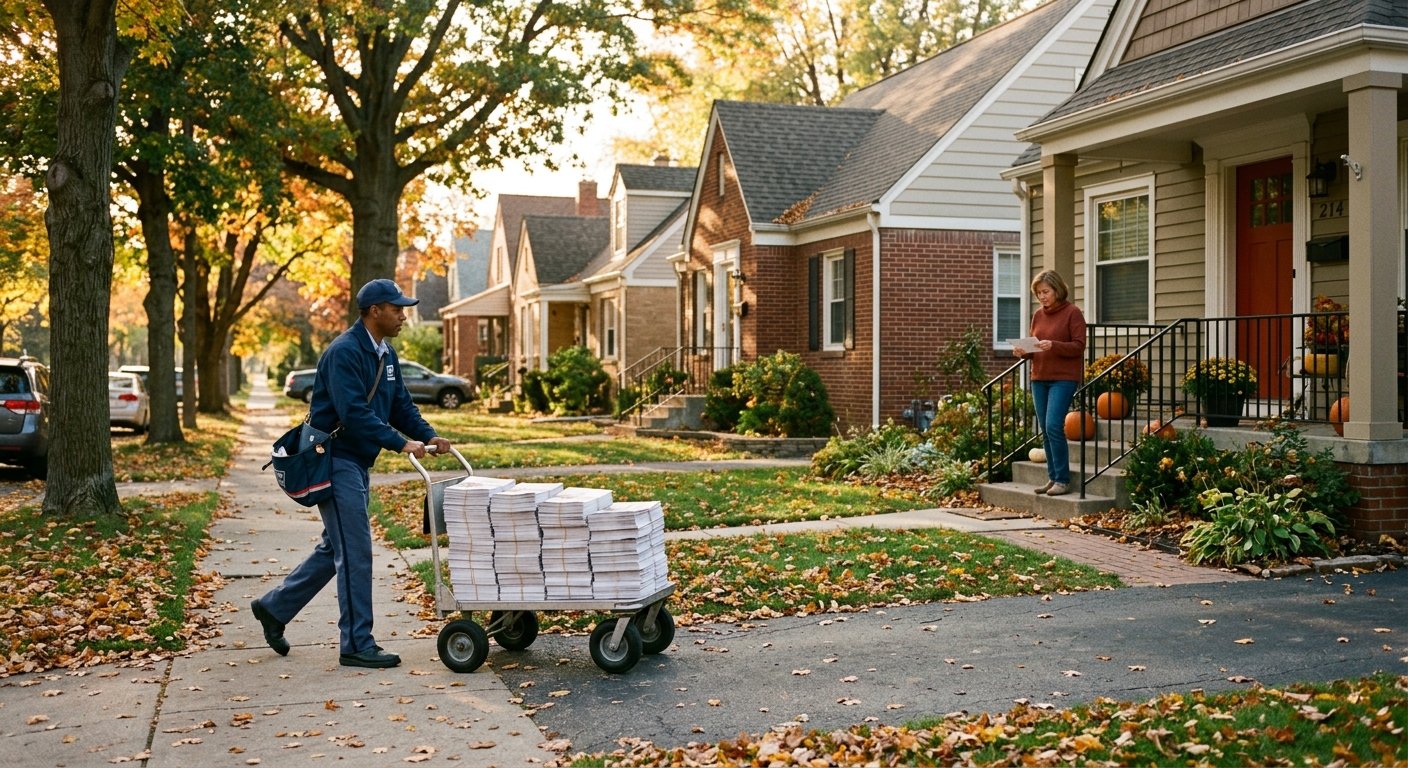
EDDM is a blunt instrument used with surgical timing. Targeted mailing lists are a scalpel. Both cut—you just need to know which cut you’re making.
Every Door Direct Mail, offered through the U.S. Postal Service’s EDDM program, lets you select carrier routes and mail to every active delivery point on those routes—residential, business, or both. No list purchase required. No names needed. You pay a flat postage rate (currently $0.26 per piece for EDDM Retail) and the USPS delivers to every door.
Targeted mailing lists work differently. You acquire a list of addresses filtered by criteria you choose—homeowners vs. renters, households above a certain income threshold, people who recently moved, or business owners in a specific industry. That targeting costs more per piece, but it also means your postcard lands in front of the right person rather than everyone on a block.
When EDDM Is the Right Call

EDDM works best when your offer is relevant to almost anyone in a geographic area, and your goal is visibility and frequency rather than precision. Here’s who typically gets the most out of it:
- Contractors running service-area campaigns: An HVAC company blanketing carrier routes in neighborhoods with homes older than 15 years before the summer cooling season is a textbook EDDM play. Same goes for a roofer responding to hail damage in a specific zip code.
- Local service businesses building brand awareness: Gyms, auto repair shops, dental offices, and restaurants benefit from saturating nearby routes because proximity is the primary qualifier—anyone close enough to visit is a prospect.
- Agents launching in a new farm area: If you’re introducing yourself to a neighborhood and haven’t yet identified specific prospects, EDDM gets your name in front of every household without the cost of a targeted list.
EDDM pieces must meet USPS size minimums—6.25″×9″ is the smallest qualifying size, with 6.5″×11″ and 6.5″×12″ being popular options. Larger pieces stand out in the mailbox and tend to drive better response. Don’t default to the smallest size just to save a few cents on printing.
The math on EDDM is compelling for high-volume saturation. For example, mailing 2,000 pieces at the current $0.26 EDDM Retail rate puts postage at $520 before printing. If your service generates $2,000 in average revenue per new customer, you need just one conversion to cover a campaign and then some.
When Targeted Mailing Lists Win

Precision matters the moment your product or offer doesn’t apply to everyone. Targeted mailing lists make sense when you’re selling something with a narrower audience—or when wasted impressions have a real dollar cost you want to eliminate.
- Real estate agents farming established neighborhoods: A 500-home farm works best when you’re mailing to verified homeowners, not renters or vacant lots. Mailing list acquisition through a full-service provider lets you filter to confirmed owner-occupied properties, increasing the percentage of recipients who can actually transact with you.
- FSBO and expired-listing outreach: These are highly specific lists—properties that listed and didn’t sell, or owners trying to sell without representation. There’s no EDDM equivalent for this kind of targeting. You need a curated list.
- Contractors targeting trigger events: A remodeling company mailing to homeowners who pulled a permit in the last 90 days, or an HVAC company targeting homes with systems over 10 years old, needs demographic and property data EDDM can’t provide.
- Mortgage and financial services: Pre-qualification campaigns often require filtering by credit range, homeownership status, or recent life events like a new mortgage—data that requires a purchased list with specific attributes.
List quality matters as much as list size. Outdated or unverified lists waste postage and printing on addresses that return nothing. Always ask how recently the list was verified before purchasing.
Side-by-Side: How They Actually Compare
| Factor | EDDM (Every Door Direct Mail) | Targeted Mailing List |
|---|---|---|
| Audience selection | Geography only (carrier route) | Geography + demographics, property data, behavior |
| Postage cost | $0.26 per piece (EDDM Retail, per USPS) | Higher (standard or first-class postage) |
| List cost | None—no list required | Varies with the data you need |
| Personalization | No name required | Can include first name, property address, custom fields |
| Best for | Saturation, awareness, broad service areas | Niche targeting, farming, trigger-based campaigns |
| Setup complexity | Lower—route selection via USPS tool | Higher—requires list acquisition and data hygiene |
| Minimum volume | 200 pieces per mailing (EDDM Retail) | No USPS minimum (varies by mail class) |
The Hybrid Approach Most Businesses Overlook
Here’s what experienced direct mail strategists know: EDDM and targeted lists aren’t mutually exclusive. Many campaigns use both in a sequence. A real estate agent might launch a new farm with an EDDM saturation drop to build name recognition across all 600 homes in a neighborhood, then follow up three months later with a targeted mailing to just verified homeowners who’ve owned their property for seven or more years—the highest-probability sellers.
A roofing contractor might EDDM an entire zip code after a hailstorm (blanket reach, fast deployment), then add a targeted layer to homeowners with insurance-eligible properties above a certain home value. Each approach reinforces the other.
The best campaign isn’t always the cheapest one—it’s the one where your message reaches the right person often enough to earn a response.
At Shop Direct Mail, we help clients think through this strategy before a single piece goes to print. That’s part of what full-service means—not just executing the job, but helping you decide which tool fits the problem. Our team handles list acquisition, campaign design, printing, and mailing under one roof, which eliminates the coordination headache of managing three vendors for one campaign.
Define your audience
Are you targeting everyone nearby, or a specific segment? Homeowners only? A certain income tier? Renters vs. owners? Start here before any other decision.
Choose your method
If your audience is “everyone on these streets,” choose EDDM. If your audience has attributes EDDM can’t filter for, build a targeted list.
Set a frequency and budget
One mailing rarely moves the needle. Plan for 6–9 touches over your campaign window. Match your per-piece cost and volume to a realistic monthly spend.
Build in tracking
Use a unique phone number, QR code, or landing page URL on every mailing so you can attribute leads. Without tracking, you’re flying blind on ROI.
Measure and adjust
After 60–90 days, review response data. Double down on what’s working. Refine the list, adjust the offer, or test a different carrier route.
Tracking Results from Either Approach
A common objection to direct mail is that it’s hard to track. That’s outdated thinking. Both EDDM and targeted campaigns are measurable when you build tracking in from the start. Use a call-tracking number unique to the mailing, a QR code pointing to a campaign-specific landing page, or a promo code that customers mention at the point of sale. USPS Informed Delivery also lets recipients preview mail digitally, creating an additional touchpoint you can track.
For hyper-local businesses, a tracked mail campaign lets you judge direct mail on your own results instead of the “print is dead” narrative.
Frequently Asked Questions
Can I use EDDM for a real estate farming campaign?
Yes, but with limitations. EDDM works for initial awareness across a neighborhood because it hits every door on a carrier route. However, if your farm strategy requires reaching only homeowners, filtering by equity position, or personalizing by name, you’ll need a targeted mailing list. Many agents start with EDDM saturation, then layer in targeted lists as their farm matures.
How much does a targeted mailing list cost?
List costs vary based on the data attributes you need. Adding filters like income, age, homeownership tenure, or credit triggers pushes the cost higher—but also improves your response rate by removing unqualified recipients. A full-service provider like Shop Direct Mail includes list acquisition as part of campaign setup, so you’re not hunting for data on your own.
What’s the minimum I need to mail with EDDM?
USPS requires at least 200 pieces per EDDM Retail mailing, and allows up to 5,000 pieces per day per ZIP Code, so a small test run is realistic even for small budgets. You can also select multiple routes in a single mailing to scale up reach.
Which approach gets better response rates?
Neither method automatically outperforms the other—it depends on how well the audience matches the offer. Targeted lists often show stronger individual response rates because the audience is more qualified. EDDM tends to generate broader awareness with lower cost-per-piece but sometimes lower individual conversion. Frequency matters for both: one mailing rarely delivers measurable results regardless of the method.
Can I personalize EDDM pieces with a name?
No. Because EDDM doesn’t require a mailing list, it doesn’t support name personalization. Pieces go to “Postal Customer” at each address. If personalization is important to your campaign—especially for real estate agents who want to address homeowners by name—a targeted mailing list is the right path.
Not Sure Which Approach Fits Your Campaign?
Tell us your goal, your audience, and your budget—we’ll help you choose the right method, build the list, design the piece, and mail it, all from one place.

About Shop Direct Mail Marketing
Shop Direct Mail is a full-service direct mail marketing partner for real estate agents, contractors, and local service businesses nationwide. We provide end-to-end strategy, design, list acquisition, printing, and mailing services that help small and medium-sized businesses cut through digital clutter with tangible, measurable campaigns. Our focus is on ROI-driven tactics like real estate farming, EDDM saturation, just-listed/just-sold postcards, and neighborhood prospecting that generate leads and customers business owners can track. Visit shopdirectmail.com →