Real estate agents invest thousands of dollars each year in postcard campaigns, yet most see disappointing results. The problem isn’t the channel—direct mail consistently delivers response rates between 1% and 5% when executed correctly, far outperforming most digital channels. The problem is execution.
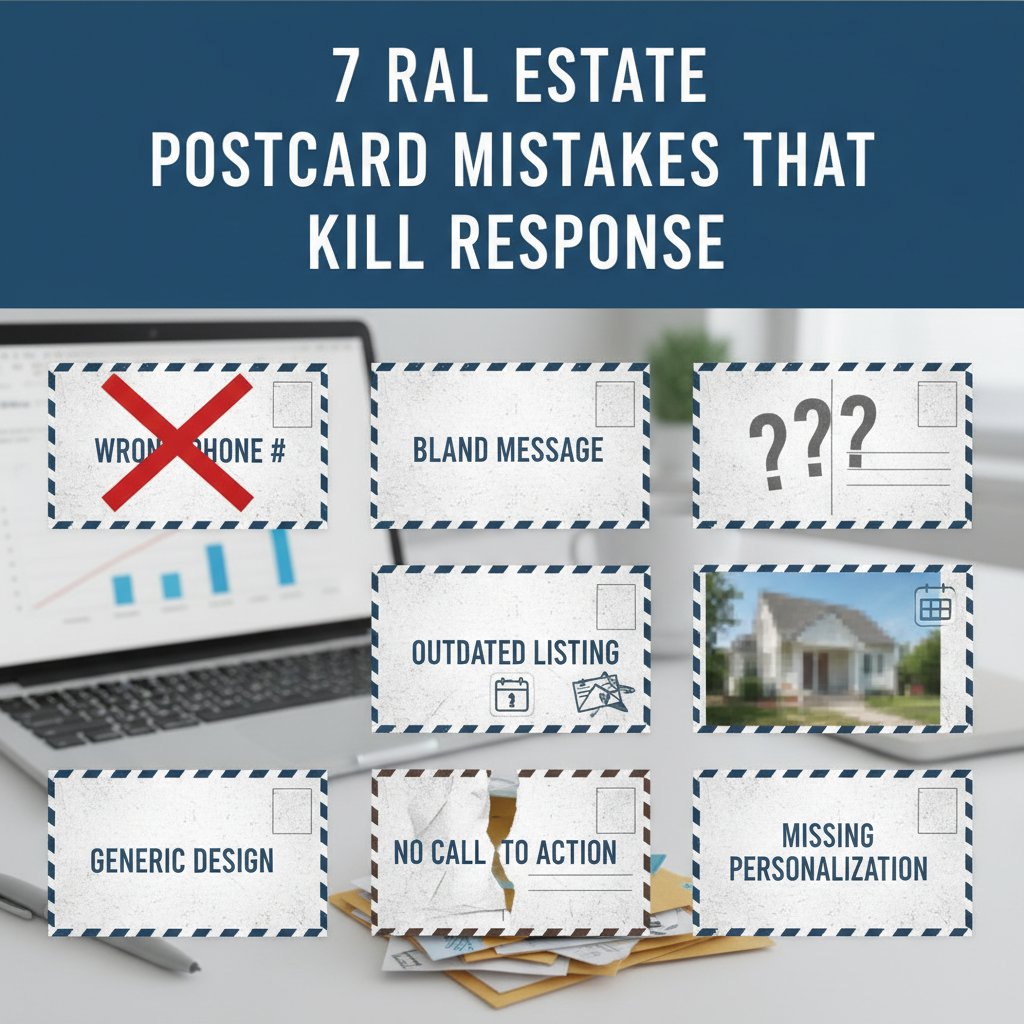
After analyzing hundreds of real estate postcard campaigns in 2026, we’ve identified seven critical mistakes that tank response rates and waste marketing budgets. More importantly, we’ll show you exactly how to fix each one so your next campaign generates actual leads instead of landfill fodder.
Mistake #1: Generic Messaging That Could Come From Any Agent
Walk to your recycling bin and look at the real estate postcards sitting there. How many say something like “Your Neighborhood Expert” or “Thinking of Selling? Call Me!” with a generic photo of the agent in a suit?
This vanilla approach gets ignored because it communicates nothing unique. Homeowners receive three to five postcards monthly from competing agents using identical messaging. Your card becomes wallpaper.
The fix: Lead with hyper-specific, neighborhood-relevant content. If you’re farming a subdivision, reference the actual street names, recent sales data, or local amenities. For just listed postcards, include the exact address, sold price, and days on market. For just sold postcards, emphasize premium results: “Sold in 8 Days at 102% of Asking—1247 Oak Street.”
This specificity accomplishes two goals: it proves you’re actively working in their neighborhood, and it gives recipients concrete data they can verify. When a homeowner sees their neighbor’s house sold above asking, they pay attention.
Mistake #2: Mailing Once or Twice and Giving Up
Real estate farming—the practice of dominating a geographic area through consistent marketing—requires patience most agents lack. They mail a neighborhood twice, see minimal response, and declare postcards “don’t work.”
The reality: meaningful response rates from cold real estate farming campaigns typically materialize after the sixth to ninth touchpoint, spanning six to twelve months. Early mailings build recognition. Later mailings convert that recognition into listing appointments when homeowners decide to sell.
The fix: Commit to a minimum nine-month campaign with monthly mailings to the same 500 to 1,000 households. Track cost-per-piece (typically $0.40 to $0.75 for designed, printed, and mailed postcards with targeted lists) and calculate your investment horizon. A 500-home farm mailed monthly for nine months at $0.50 per piece costs $2,250. If that generates two listings, your cost-per-listing is $1,125—a bargain compared to portal leads or paid referrals.
Shop Direct Mail’s full-service approach handles strategy, design, list acquisition, printing, and mailing so you maintain consistency without coordinating multiple vendors each month. Consistency wins farming campaigns, not creative genius.
Mistake #3: Weak or Missing Calls-to-Action
Too many real estate postcards end with vague directives: “Contact me for a free market analysis” or “Visit my website.” These CTAs lack urgency and specificity, so recipients file them mentally under “maybe later” and never act.
The fix: Use time-bound, benefit-specific calls-to-action tied to real value. Examples that work:
- “Text HOME to [number] for instant access to your home’s current value—response in 60 seconds”
- “Scan this QR code to see what homes like yours sold for in March 2026”
- “Call [tracking number] before May 31st for a complimentary pre-listing consultation—slots limited to 3 per week”
Notice the pattern: immediate gratification, clear benefit, implied scarcity or speed. Also notice the tracking mechanisms—text keywords, QR codes, and dedicated phone numbers let you measure exactly which mailings drive response.
In 2026, QR codes have become standard on real estate postcards, with scan rates between 8% and 15% when the value proposition is clear. Don’t just slap a QR code on your card; make the destination worth the scan.
Mistake #4: Targeting the Wrong Lists
Many agents buy the cheapest mailing lists available or mail entire zip codes indiscriminately, wasting half their budget on renters, recent buyers unlikely to move soon, or demographics mismatched to their expertise.
List quality determines campaign success more than design or copy. A gorgeous postcard sent to the wrong people produces zero return.
The fix: Invest in refined list criteria that match your ideal client profile. For real estate farming, target:
- Owner-occupied homes (exclude rentals and investment properties unless that’s your niche)
- Length of ownership (7+ years often indicates higher move likelihood)
- Home value ranges aligned with your market expertise
- Age and family demographics if you specialize in downsizers, growing families, or first-time buyers
For just listed postcards and just sold postcards, mail concentric circles around the property: immediate neighbors receive proof you’re active, and nearby homeowners considering a sale see your results. Start with a 0.25-mile radius (typically 300–500 addresses) and expand based on budget.
Alternatively, USPS Every Door Direct Mail (EDDM) lets you saturate entire carrier routes at $0.20 to $0.25 per piece without purchasing lists—ideal for new agents building recognition or established agents maintaining top-of-mind awareness in their farm areas. EDDM requires specific size formats like 6.25″×9″ or 6.5″×12″ and hits every deliverable address on the route, including renters.
Mistake #5: Designing for Yourself Instead of Your Audience
Agents frequently design postcards they personally find attractive—minimalist layouts, muted colors, artistic photography—without considering what motivates a 55-year-old homeowner sorting mail over the recycling bin.
Your postcard has three seconds to earn attention. Elegant subtlety loses to bold clarity every time.
The fix: Design for scannability and immediate comprehension:
- Use high-contrast headlines in 24-point font or larger
- Feature property photos prominently on just listed and just sold cards—homeowners want to see the house, not your headshot
- Limit text blocks to three lines maximum; use bullet points for easy scanning
- Place your most important message and CTA above the fold on 6″×11″ formats
- Include your headshot, but keep it smaller than the property photo
Color psychology matters in real estate marketing. Red and orange drive urgency (good for “Just Sold” and “Just Listed” messaging), while blue conveys trust and stability (effective for market updates and farming). Test both approaches in your farm area, but avoid muddy browns and grays that blend into the recycling pile.
If design isn’t your strength, Shop Direct Mail’s design services translate your content into high-converting layouts optimized for real estate response rates, eliminating the guesswork.
Mistake #6: Ignoring Back-Side Real Estate
The back of your postcard is premium space, yet many agents leave it sparse or fill it with redundant contact information already on the front.
When a recipient flips your postcard—and most do—you have a second chance to communicate value. Wasting it is leaving money on the table.
The fix: Use the back strategically:
- On just sold postcards, show a “Homes I’ve Sold in Your Area” grid with addresses, photos, sold prices, and days on market
- On farming postcards, include a neighborhood market snapshot: median sale price, average days on market, inventory levels, and three-month trends
- On just listed postcards, highlight property features with bullets and include a clear “Know someone interested?” referral CTA with your contact details
- Include client testimonials with full names and neighborhoods (with permission) to build trust
The back side should reinforce your front-side message and provide additional proof points that you’re the area expert worth calling when it’s time to sell.
Mistake #7: No Tracking Mechanism, So You Can’t Measure ROI
The most expensive mistake is mailing without tracking. When you can’t measure response, you can’t optimize, and you can’t justify continued investment in campaigns that actually work.
Many agents blame “postcards don’t work” when the real problem is “I have no idea which postcards work because I never measured.”
The fix: Implement multiple tracking layers:
- Dedicated phone numbers using call-tracking services (CallRail, CallTrackingMetrics) assigned to specific campaigns so you know exactly which mailing generated each call
- Unique landing pages or URLs (YourName.com/spring2026) that only appear on specific postcard batches
- QR codes linking to trackable URLs with UTM parameters
- Text-to-respond keywords that capture leads automatically and attribute them to the correct campaign
- Promo codes for any special offers that let you trace conversions
Ask every lead, “How did you hear about me?” during your first conversation and log responses in your CRM. Over six months, patterns emerge that show which mailings, messages, and neighborhoods deliver the best return.
Calculate true ROI by dividing revenue generated (commissions from listings and sales) by total campaign cost (design, printing, postage, and list acquisition). Real estate farming campaigns delivering a 5:1 ROI or better within the first year are performing well. Top performers see 10:1 or higher once their farm reaches maturity after 18 to 24 months of consistent mailing.
Putting It All Together: Your Next Campaign Blueprint
Fix these seven mistakes and your next real estate postcard campaign will outperform 80% of agent mailings hitting mailboxes in 2026. Here’s your action checklist:
- Choose a farm area of 500–1,000 homes and commit to nine months minimum
- Refine your mailing list with owner-occupancy, length of ownership, and value filters
- Design bold, benefit-focused postcards with neighborhood-specific content
- Include compelling, time-bound CTAs with clear tracking mechanisms
- Maximize back-side space with proof points, testimonials, and data
- Mail consistently—monthly or every six weeks without gaps
- Track every response and calculate ROI at 90, 180, and 270 days
Remember, direct mail isn’t magic. It’s math. Response rates typically range from 0.5% to 2% for cold farming and 3% to 5% for circle prospecting around just listed and just sold properties. On a 500-piece mailing, 1% response means five phone calls or inquiries. If your conversion rate from inquiry to listing is 20%, that’s one listing per mailing. Run the numbers for your market, average commission, and cost per piece to determine profitability.
The agents who win with real estate postcards in 2026 aren’t necessarily the most creative or the biggest spenders. They’re the ones who show up consistently, track religiously, and refine continuously based on data.
Frequently Asked Questions
What’s a realistic response rate for real estate farming postcards?
For cold real estate farming to homeowners who don’t know you, expect 0.5% to 1.5% response rates in the first six months, increasing to 1.5% to 3% after nine to twelve months of consistent monthly mailings. Just listed and just sold circle prospecting typically delivers 2% to 5% response because you’re mailing recent proof to warm audiences already thinking about real estate.
How much should I budget per postcard including design, printing, and mailing?
Full-service real estate postcards—including design, professional printing, targeted list acquisition, and first-class postage—typically cost between $0.40 and $0.75 per piece depending on quantity, size, and list complexity. EDDM campaigns run $0.35 to $0.50 per piece total since postage is lower and you skip list costs. Always calculate total cost per piece, not just printing, to budget accurately.
Should I use EDDM or targeted mailing lists for my farm area?
EDDM works well for brand awareness in tight geographic areas where you want total saturation including renters, but targeted lists perform better for lead generation because you exclude renters and focus on owner-occupants with higher move probability. Many successful agents use EDDM for general farming and switch to refined lists for just listed/just sold circle prospecting where conversion matters more than reach.
How long should I mail a farm area before expecting results?
Plan for a minimum six-month commitment with monthly mailings, but most agents see meaningful listing inquiries starting around month seven through twelve. Real estate farming is a long game—you’re building recognition so when homeowners decide to sell (on their timeline, not yours), you’re the obvious choice. Agents who quit after three months waste their early investment right before it would have paid off.
What’s the best call-to-action for a real estate farming postcard?
The most effective CTAs offer immediate, low-commitment value: instant home valuations via text or QR code, access to recent neighborhood sales data, or free market reports. Avoid high-friction CTAs like “schedule a listing appointment”—that’s the eventual goal, but early touches should focus on starting a relationship, not closing a deal.
How do I track which postcards generate leads and listings?
Use dedicated tracking phone numbers for each campaign, unique URLs or QR codes with analytics, and text-response keywords. Always ask new leads “How did you hear about me?” and log answers in your CRM. Track both immediate response (calls and clicks within two weeks of mailing) and delayed response (contacts who mention your postcards months later when they’re ready to list).
Ready to Launch a Campaign That Actually Converts?
Avoiding these seven mistakes separates profitable real estate postcard campaigns from budget-draining failures. But strategy is only half the battle—execution matters just as much.
Shop Direct Mail handles strategy, design, list acquisition, printing, and mailing so you focus on converting leads instead of coordinating vendors. Whether you’re launching your first farm area or refining an existing campaign, our team brings real estate marketing expertise that translates into measurable results.
Explore our real estate postcard templates, EDDM services, and full-service campaign management at Shop Direct Mail, or contact our team to map out a custom farming strategy for your market. Your next listing is sitting in a mailbox—let’s make sure your postcard is the one that earns the call.