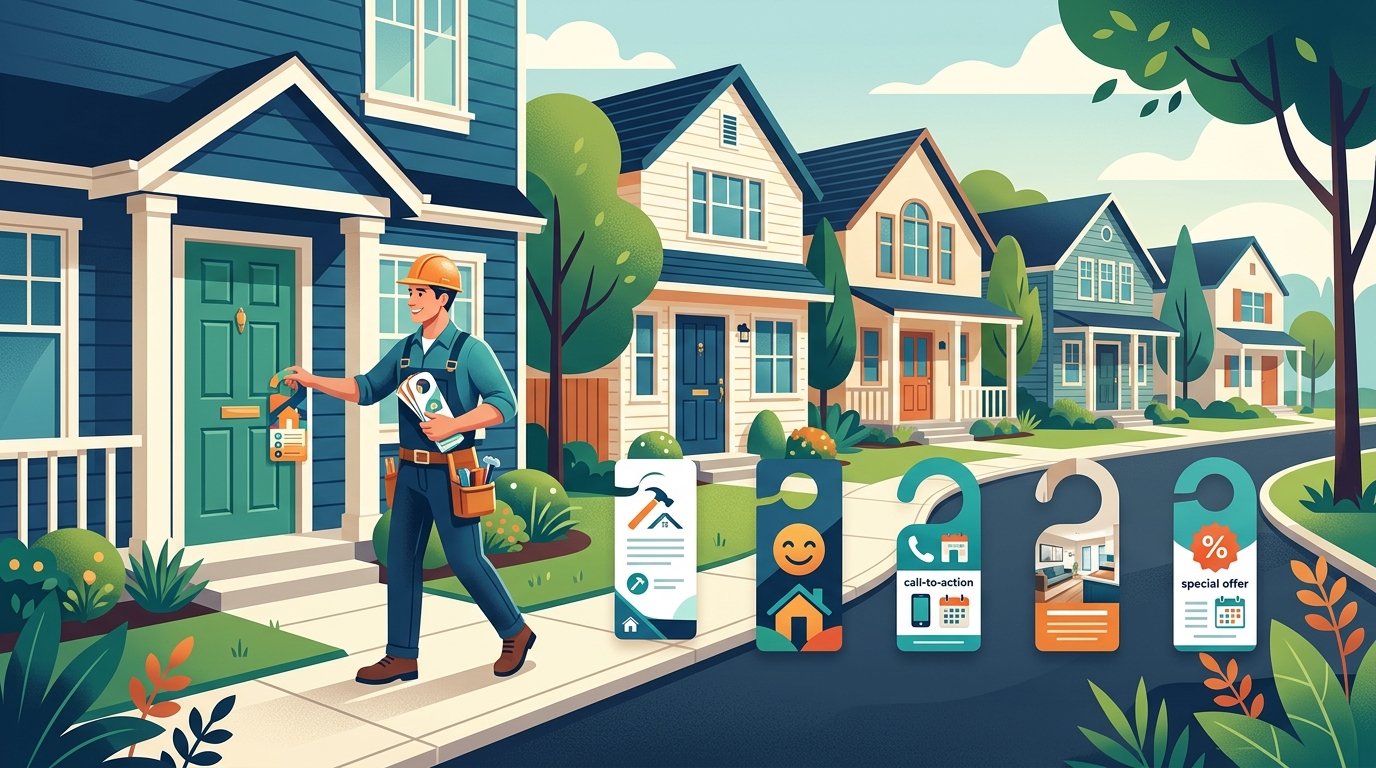
A door hanger gets about three seconds of attention before someone decides to read it or toss it. That’s not a reason to panic — it’s a reason to design smarter. Contractors who nail their door hanger design consistently report response rates in the 1%–3% range, and in neighborhoods where you’re already working, that number climbs even higher because the social proof is baked in (“we just finished the job two doors down”).
This guide breaks down five proven design strategies that make contractor door hangers generate real leads — not just impressions. Whether you’re running HVAC maintenance specials, roofing estimates after a storm, or landscaping packages before spring, these tactics apply directly to your next campaign.
Why Door Hangers Still Work for Contractors in 2026
Door-to-door digital fatigue is real. The average American household sees hundreds of digital ads daily, and open rates for cold email hover below 20%. A physical door hanger on a front door knob gets seen — full stop. There’s no spam filter. No algorithm to beat. No competing thumbnails.
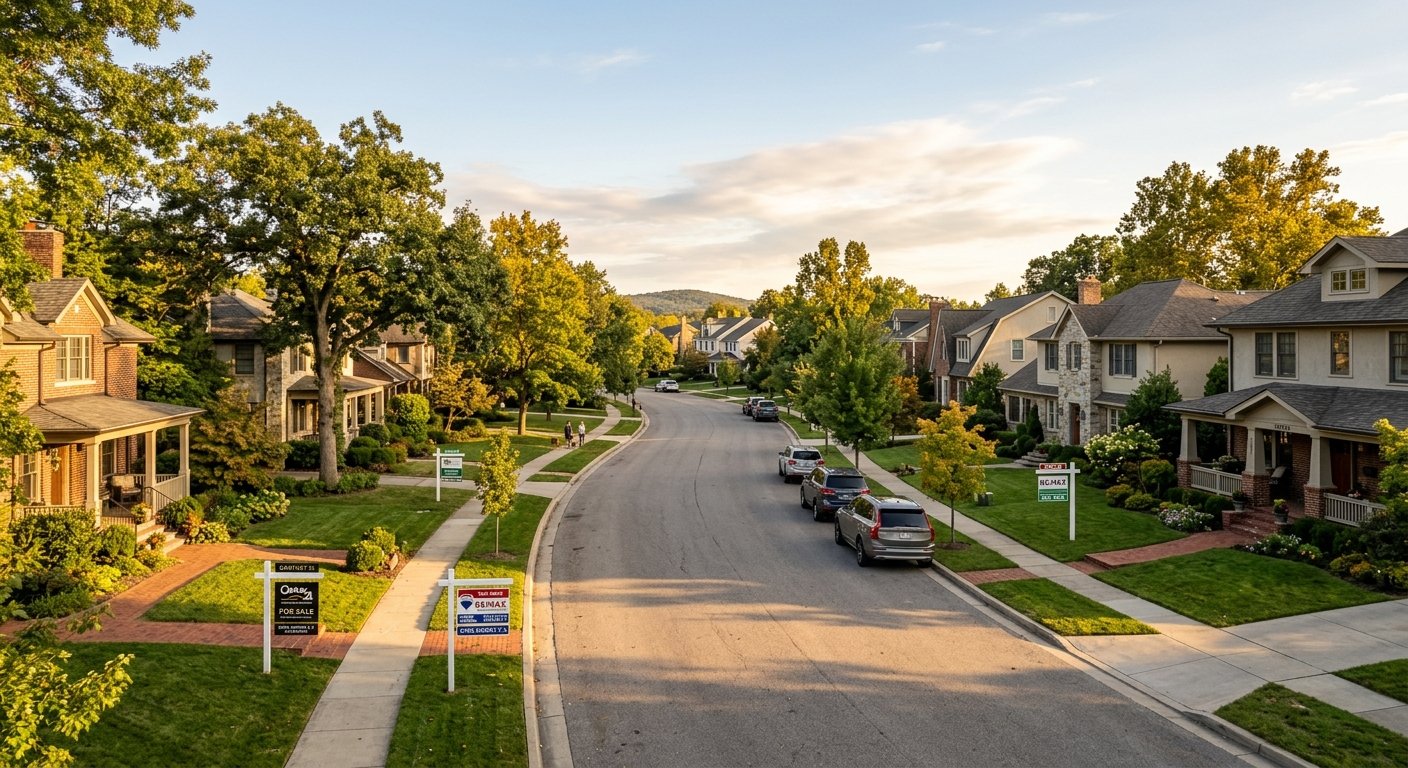
For contractors, the geography advantage is even more powerful. You can target specific carrier routes, zip codes, or individual streets with surgical precision. An HVAC company can mail homeowners in zip codes with older housing stock. A roofer can blanket neighborhoods hit by a hail event within days. A landscaper can target the 300 homes surrounding a completed project for maximum “I saw your work at the Hendersons'” effect.
According to the USPS direct mail data, physical mail has a 90%+ household reach rate, meaning virtually everyone touches it. For hyper-local contractor campaigns, that kind of saturation is hard to replicate digitally at a comparable cost per household.
Now let’s talk about what makes the design work.
Strategy 1: Lead With the Neighborhood Connection
The single most powerful line on any contractor door hanger isn’t your company name — it’s a hyperlocal headline that makes the homeowner feel like you’re already their neighbor’s contractor.
Examples that work:
- “We just completed a roof replacement on Oak Ridge Drive.”
- “Your neighbor on Elmwood called us for their AC — here’s a special offer for your street.”
- “Currently working in [Subdivision Name] — limited slots this month.”
This isn’t flattery. It’s context. Homeowners are far more likely to trust a contractor who has verifiable local work. When you can honestly say “we’re in this neighborhood right now,” you’ve eliminated the biggest friction point: who is this company and can I trust them?
Design tip: Put the neighborhood reference in your headline, above the fold, in large bold text. Don’t bury it in a paragraph on the back.
Strategy 2: Make Your Offer Specific and Time-Bound
Vague door hangers produce vague results. “Call us for a free estimate” is fine, but it creates no urgency. A specific, expiring offer gives someone a reason to act this week rather than “someday.”
High-performing offers by trade:
- HVAC: “$79 AC tune-up through July 31 — limited to first 20 calls”
- Roofing: “Free 15-point inspection for homes in this route — offer expires in 14 days”
- Landscaping: “Book a spring cleanup by [date] and get mulching included”
- Pest Control: “Quarterly plan discount if you schedule before [month]”
- Plumbing: “Whole-home inspection for $49 — mention this hanger”
The “mention this hanger” instruction does double duty: it tracks response and reinforces that the offer is exclusive to this neighborhood drop. That perceived exclusivity matters.
Design tip: Use a colored box, badge, or starburst to visually isolate the offer. The human eye gravitates to contained shapes, and your offer should be impossible to miss even on a three-second glance.
Strategy 3: One Clear Call to Action, Not Three
This is where most contractor door hangers fall apart. The piece has a phone number, a website, a QR code, and a request to “follow us on social media” — and the homeowner does nothing because they can’t figure out what you actually want them to do.
Pick one primary action and design everything around it. In most cases for contractors, that’s a phone call. Make the number large — think 36–44pt font — and position it in the lower third of the front panel where the eye naturally lands after reading top to bottom.
If you want to track digital conversions, add a QR code as a secondary option, but make it clearly subordinate to the phone number. Something like: “Call us at [number] or scan to get your quote online.” One path. One decision.
Tracking is non-negotiable. Use a unique call-tracking number for each door hanger campaign so you know exactly which drop generated which calls. This is how you do real ROI math: if a batch of 500 door hangers costs $180 and generates 8 calls that convert to 3 jobs averaging $900 each, you’ve turned $180 into $2,700. That’s a number worth repeating to yourself when you’re deciding whether to run the next campaign.
At Shop Direct Mail, we set up unique tracking numbers and QR codes as part of the design process so this data is ready before a single hanger gets printed.
Strategy 4: Use Before/After Photography or Proof Imagery
Stock photos of smiling contractors shaking hands don’t build trust. Real project photography does. A before/after of a roof replacement, a freshly remodeled bathroom, or a lawn transformation tells the homeowner exactly what they’re buying — and makes the investment feel tangible.
You don’t need a professional photographer for this. A clean, well-lit smartphone photo of a completed project works. What matters is authenticity. Homeowners can spot stock imagery immediately, and it triggers skepticism rather than confidence.
Design considerations for proof imagery:
- Use a two-panel layout — before on the left, after on the right — with a simple dividing line
- Add a brief caption: “Completed March 2026 — [City], [Neighborhood Name]”
- If possible, include the homeowner’s first name and a one-line quote (with permission)
- Avoid low-resolution photos — anything under 300 DPI will print blurry and undermine your credibility
The FTC’s endorsement guidelines apply to testimonials even in print — make sure any quotes you use are genuine and not embellished.
Strategy 5: Size and Format Are Part of the Design
Most contractors default to a standard 4″×11″ door hanger template. That’s fine — it’s the industry standard for a reason. But larger formats like 4.25″×14″ or even oversized 5.5″×17″ panels command significantly more visual real estate and tend to feel more premium in hand.
If your job average is $2,000 or more (roofing, remodeling, HVAC system replacements), investing in a larger, heavier-stock hanger makes economic sense. A thicker 14pt card stock with UV coating signals quality before anyone reads a word. It’s a physical stand-in for your company’s reputation.
For high-volume saturation campaigns — especially for lower average tickets like pest control, gutter cleaning, or lawn care — standard 4″×11″ with a clean design and strong offer is the cost-efficient play. You’re going for reach, not premium positioning.
One format note: if you’re running EDDM-style saturation alongside door hangers, the USPS EDDM program allows flat mail pieces (minimum 6.25″×9″) at retail rates of approximately $0.20–$0.25 per piece, which can complement a door hanger blitz in the same neighborhood. Learn more about how EDDM works for contractors as part of a layered local campaign.
Putting It All Together: A Sample Campaign
Here’s what a well-executed contractor door hanger campaign looks like in practice:
A roofing company in a metro area identifies a zip code with homes averaging 15–20 years old — prime for roof replacement conversations. They print 1,000 door hangers (4.25″×14″, 14pt UV) featuring a before/after photo from a recent local job, a headline reading “Currently working in [Subdivision] — free 15-point inspection this month only,” a tracked phone number, and a QR code linking to a simple landing page.
They drop 500 hangers week one, 500 week two. They receive 22 calls, convert 9 inspections, and close 4 jobs averaging $8,500 each. Total print and distribution cost: approximately $600. Revenue generated: $34,000. That’s not a typical outcome for every campaign — but it illustrates why contractors who take design seriously get dramatically different results than those who don’t.
Frequently Asked Questions
How many door hangers should I print for my first campaign?
For most contractors, 500–1,000 is a solid starting point for testing. It’s enough volume to generate statistically meaningful data on response rate without overcommitting budget. Scale up once you’ve validated your offer and design.
Should I distribute door hangers myself or hire a service?
Both options work, but professional distribution ensures accountability and GPS verification. Self-distribution works for very small campaigns where you or your crew can cover the route systematically. For campaigns over 500 pieces, professional distribution is worth the additional cost.
How do I track whether my door hangers are generating leads?
Use a unique call-tracking phone number specific to the campaign, a campaign-specific QR code, or a promo code that callers mention. These methods let you attribute every lead directly to the hanger and calculate your actual cost per lead.
What’s a realistic response rate for contractor door hangers?
Cold neighborhood drops typically generate 0.5%–2% response rates. Campaigns in neighborhoods where you’ve recently completed visible work often perform at the higher end or above that range because name recognition and social proof do some of the selling for you.
Can I combine door hangers with direct mail for the same area?
Absolutely — and this is often the most effective approach. Door hangers get seen immediately at the point of contact. A follow-up postcard or EDDM piece a week later reinforces your message and increases conversion. Multi-touch campaigns consistently outperform single-touch drops.
Ready to Run a Campaign That Actually Converts?
Shop Direct Mail handles every step of your contractor door hanger campaign — strategy, design, printing, and distribution — so you’re not coordinating between three different vendors or guessing at what works. We’ve run thousands of campaigns for contractors across every trade and we know what drives calls.
Explore our full contractor marketing services and get a campaign built around your trade, your territory, and your actual revenue goals. No fluff, no guesswork — just door hangers that work.