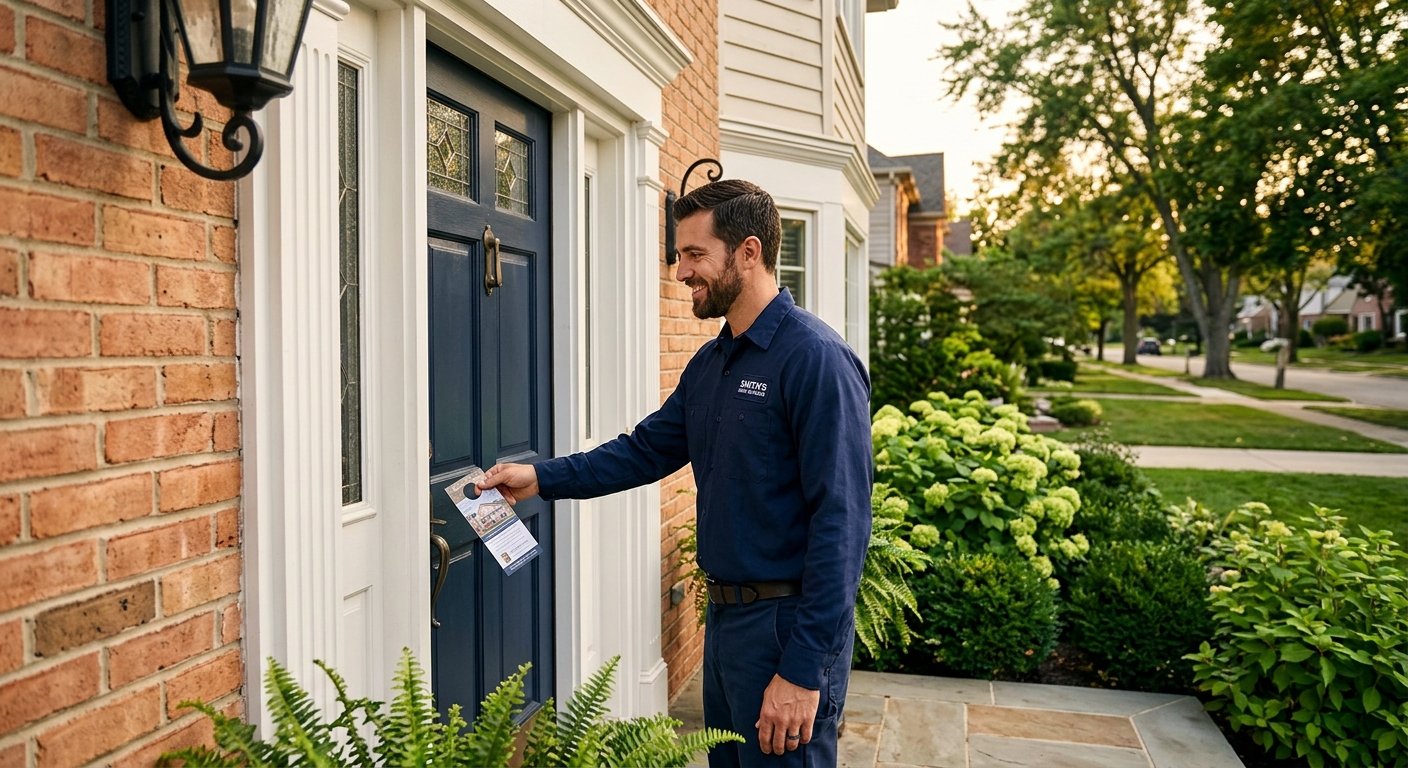
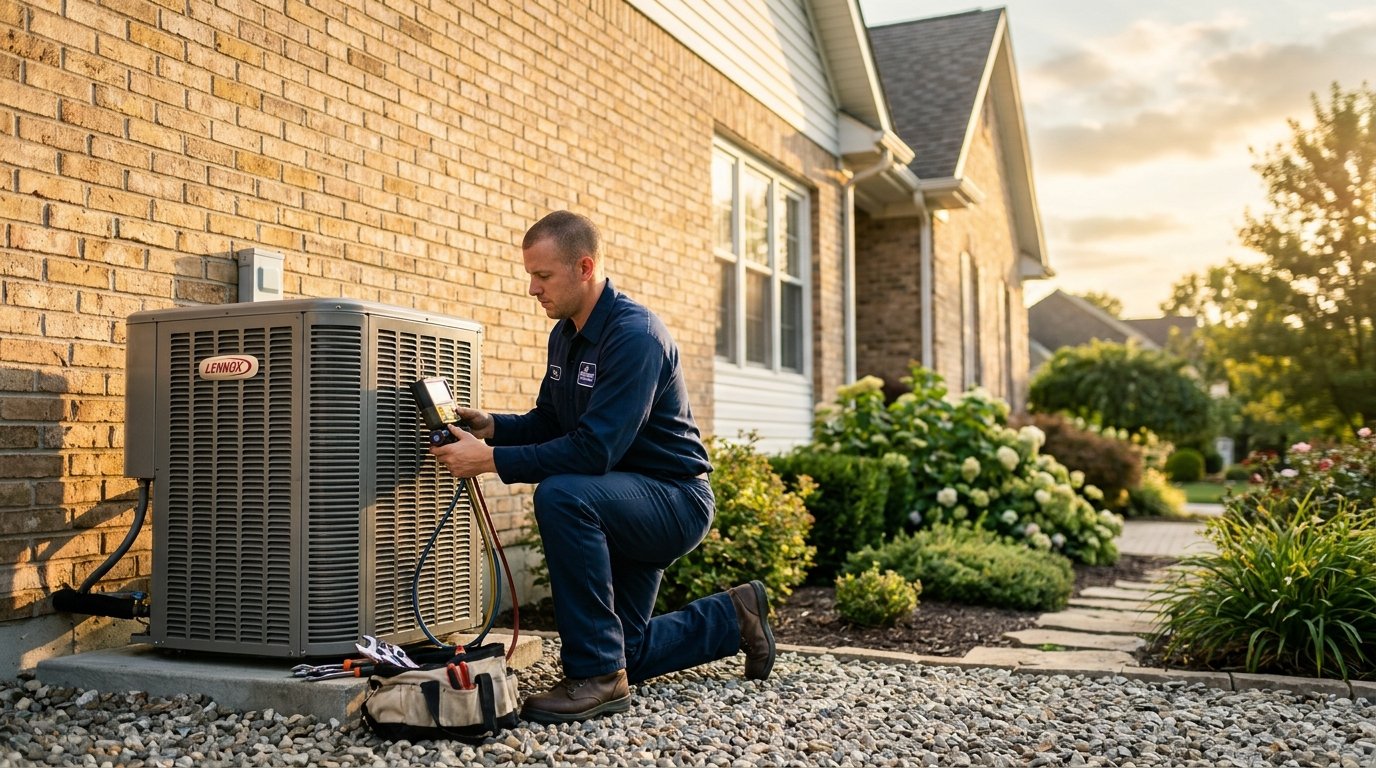
HVAC direct mail works by targeting homeowners in specific carrier routes or zip codes with a postcard or door hanger timed to seasonal demand — before summer heat or winter cold hits. Done right, it drives inbound service calls, maintenance agreements, and equipment replacements that you can track back to a specific mailing. This guide walks through every step, from audience targeting to ROI measurement.
- Seasonal timing is everything — mail 4–6 weeks before your busiest service windows.
- EDDM carrier-route saturation is the most cost-efficient way to blanket a neighborhood without buying a list.
- Personalized postcards on 14pt card stock outperform flimsy mailers on perceived professionalism.
- Call-tracking numbers, QR codes, and promo codes make every campaign measurable.
- Consistency wins — one mailing rarely moves the needle; a 3–4 touch sequence does.
Why Direct Mail Still Works for HVAC Contractors

Digital advertising is crowded. Homeowners scroll past five banner ads before they finish their morning coffee. A well-designed postcard sitting on the kitchen counter is a different story — it’s physical, it’s local, and it’s there when the A/C acts up at 2 p.m. on a Tuesday.
According to the USPS Office of Inspector General, physical mail engages different cognitive processes than digital content, increasing the likelihood of brand recall. Separately, the American Marketing Association has noted that direct mail consistently produces higher response rates than most digital channels for local service businesses. The key is targeting the right households at the right time — which is exactly what a structured HVAC campaign does.
Contractor marketing through direct mail also sidesteps the bidding wars of pay-per-click advertising. You pay a predictable cost per piece, your message lands in the home, and you own the list relationship long-term.
Step 1 — Define Your Target Audience

Not every homeowner is worth the same postage. For HVAC contractors, the highest-value targets share predictable characteristics:
- Homeowners, not renters — renters don’t book HVAC installs or replacement units.
- Homes built 10–20+ years ago — systems are aging and replacement is realistic.
- Specific carrier routes — neighborhoods close to your service territory keep drive time and dispatch costs low.
- Income threshold — households with the budget for a $4,000–$8,000 system replacement or a $200 maintenance agreement.
You have two main targeting paths. EDDM (Every Door Direct Mail) saturates every address on a carrier route — no list required, lower postage rates, and ideal when your goal is neighborhood brand awareness. Targeted mailing lists go deeper: filter by home age, ownership status, estimated home value, or even whether a homeowner has searched for HVAC services. Shop Direct Mail handles both — list acquisition is part of the full-service stack, so you’re not chasing down a separate list broker.
Learn more about carrier-route saturation on our Every Door Direct Mail page.
Step 2 — Build Your Seasonal Campaign Calendar

Timing is the variable HVAC contractors most often get wrong. Mailing during a heat wave means your postcard arrives after the homeowner already called a competitor. The goal is to land in the mailbox 4–6 weeks before demand peaks.
Pre-Summer (April–May)
Push A/C tune-ups, maintenance agreements, and system inspections. Homeowners are thinking about cooling before they need it urgently. This is your highest-volume mailing window.
Pre-Winter (September–October)
Promote heating system check-ups, furnace maintenance, and smart thermostat installs. Urgency is lower than summer, but conversion on maintenance agreements is strong.
Storm or Event Follow-Up (Any Time)
After a severe weather event damages equipment, deploy a rapid-response mailing to affected zip codes within 10–14 days. These campaigns have some of the highest call-to-mail ratios in contractor marketing.
Year-Round Remarketing (Ongoing)
Mail your existing customer list a service-anniversary reminder or maintenance renewal offer every 10–12 months. Reactivating a past customer almost always costs less than acquiring a new one.
Step 3 — Design a Postcard That Gets Read
Your postcard has about three seconds of attention before it lands in the recycling bin or on the counter. That three seconds has to do real work.
Front of the Card
- One bold headline — make it about the homeowner’s problem, not your company name. “Is Your A/C Ready for Summer?” beats “Joe’s HVAC — 20 Years of Service.”
- A clear, single offer — a discounted tune-up, a free system assessment, or a maintenance package. One call to action per card.
- Your phone number and a QR code — both, so the homeowner can call directly or scan to a landing page.
Back of the Card
- Three to five trust signals — licenses, service area, years in business, any manufacturer certifications you hold.
- A short list of services (don’t bury the reader in paragraphs).
- Expiration date on any offer — urgency without pressure.
Print on 14pt premium card stock with UV gloss coating. When a homeowner picks it up, the weight and finish signal quality before they read a single word. Thin, flimsy mailers undercut even the best offer.
EDDM-eligible postcards must meet USPS size minimums — the most popular formats are 6.25″×9″, 6.5″×11″, and 6.5″×12″. Full specs are published on USPS.com’s EDDM resource page. Shop Direct Mail’s design team builds to these specs automatically, so your cards qualify without back-and-forth corrections.
One clear offer, one bold headline, one phone number — the best HVAC postcards never make the homeowner think too hard.
Step 4 — Set Your Mailing Frequency
A single mailing is rarely enough. Homeowners need to see your name multiple times before they reach for the phone. A realistic rule of thumb: plan for at least three to four touches per household before expecting meaningful inbound volume. This is not unique to direct mail — it reflects how buyers of any service make decisions.
| Campaign Type | Recommended Touches | Interval |
|---|---|---|
| Seasonal tune-up promotion | 2–3 mailings | Every 3–4 weeks |
| Neighborhood awareness / branding | 4–6 mailings | Monthly or bi-monthly |
| Storm-response rapid deploy | 1–2 mailings | Within 2 weeks of event |
| Customer reactivation | 1–2 mailings | Annual service anniversary |
Budget with this cadence in mind from the start. Spreading a thin budget across too many households with a single mailing typically produces weaker results than mailing a tighter, more targeted list three to four times.
Step 5 — Track Every Campaign
Direct mail is not a “set it and forget it” channel — it’s a measurable one. Here’s how to close the loop:
- Call-tracking numbers — assign a unique phone number to each campaign. When it rings, you know exactly which mailing triggered the call.
- Unique landing page URLs or QR codes — homeowners who prefer to scan rather than call will hit a trackable landing page tied to that specific mailing.
- Promo codes — “Mention code SPRING26 for $20 off your tune-up” ties booked jobs directly to the postcard.
- USPS mailing receipts — Shop Direct Mail provides a time-stamped USPS Form 8125 or 3602 mailing receipt for every campaign, so you have a verifiable record of when your mail dropped.
Say you mail 2,000 postcards at an approximate all-in cost of $1.00 per piece (design, print, postage). If that mailing generates 20 booked service calls at $150 average ticket, your gross revenue from the campaign is $3,000 against a $2,000 spend. That math improves substantially when those customers convert to annual maintenance agreements. These are illustrative numbers — your actual results will depend on offer strength, list quality, and local market conditions.
Putting It All Together With a Full-Service Partner
The biggest time sink for HVAC contractors isn’t designing a postcard — it’s coordinating a designer, a list broker, a printer, and a mail house as four separate vendors. Miss one step and the campaign stalls. Shop Direct Mail handles strategy, design, list acquisition, printing, and mailing under one roof, so you’re managing one conversation instead of four.
Our direct mail marketing services are built around campaigns like this — contractor postcards, door hangers, and EDDM saturation for businesses that need measurable results, not a generic template. And if you’re running a just-listed or just-sold campaign on the side, our real estate postcards are built for that too.
Frequently Asked Questions
What’s the difference between EDDM and a targeted mailing list for HVAC?
EDDM saturates every address on a postal carrier route — no list purchase required, and postage rates are lower. It’s ideal for neighborhood awareness and broad seasonal campaigns. A targeted mailing list lets you filter by homeowner status, home age, income, and other factors so you’re only paying to reach the households most likely to book a service. EDDM costs less per piece; targeted lists cost more but typically produce better-qualified leads.
How far in advance should I mail before my busy season?
Plan to have postcards in mailboxes 4–6 weeks before your peak demand window. For most HVAC contractors, that means mailing in mid-April for summer A/C season and mid-September for heating season. This gives homeowners time to book before their system fails and your schedule fills.
How do I track whether my direct mail campaign is generating calls?
The most reliable method is a unique call-tracking phone number printed on each campaign. When it rings, the source is confirmed. You can layer in QR codes to a dedicated landing page and promo codes for redeemed offers. Shop Direct Mail also provides a USPS mailing receipt (Form 8125 or 3602) so you have a timestamped record of when each campaign deployed.
How many times should I mail the same neighborhood?
For a seasonal promotion, two to three mailings spaced three to four weeks apart is a reasonable starting point. For ongoing neighborhood branding, a monthly or bi-monthly cadence over six or more months builds the name recognition that makes homeowners think of you first when their system breaks. Consistency over time outperforms a single large mailing.
What postcard size works best for HVAC campaigns?
For EDDM campaigns, the 6.5″×11″ format is one of the most popular — it meets USPS size minimums, stands out in the mailbox, and gives you enough space for a headline, offer, and trust signals without crowding. Smaller standard postcards work for targeted list campaigns where cost-per-piece matters more than mailbox presence. USPS publishes current EDDM size requirements at usps.com.
Ready to Book More Service Calls This Season?
Tell us your service area and target season — we’ll put together an HVAC direct mail campaign with strategy, design, list, print, and mailing handled for you.

About Shop Direct Mail Marketing
Shop Direct Mail is a full-service direct mail marketing partner for real estate agents, contractors, and local service businesses nationwide. We provide end-to-end strategy, design, list acquisition, printing, and mailing services that help small and medium-sized businesses cut through digital clutter with tangible, measurable campaigns. Our focus is on ROI-driven tactics like real estate farming, EDDM saturation, just-listed/just-sold postcards, and neighborhood prospecting that generate leads and customers business owners can track. Visit shopdirectmail.com →