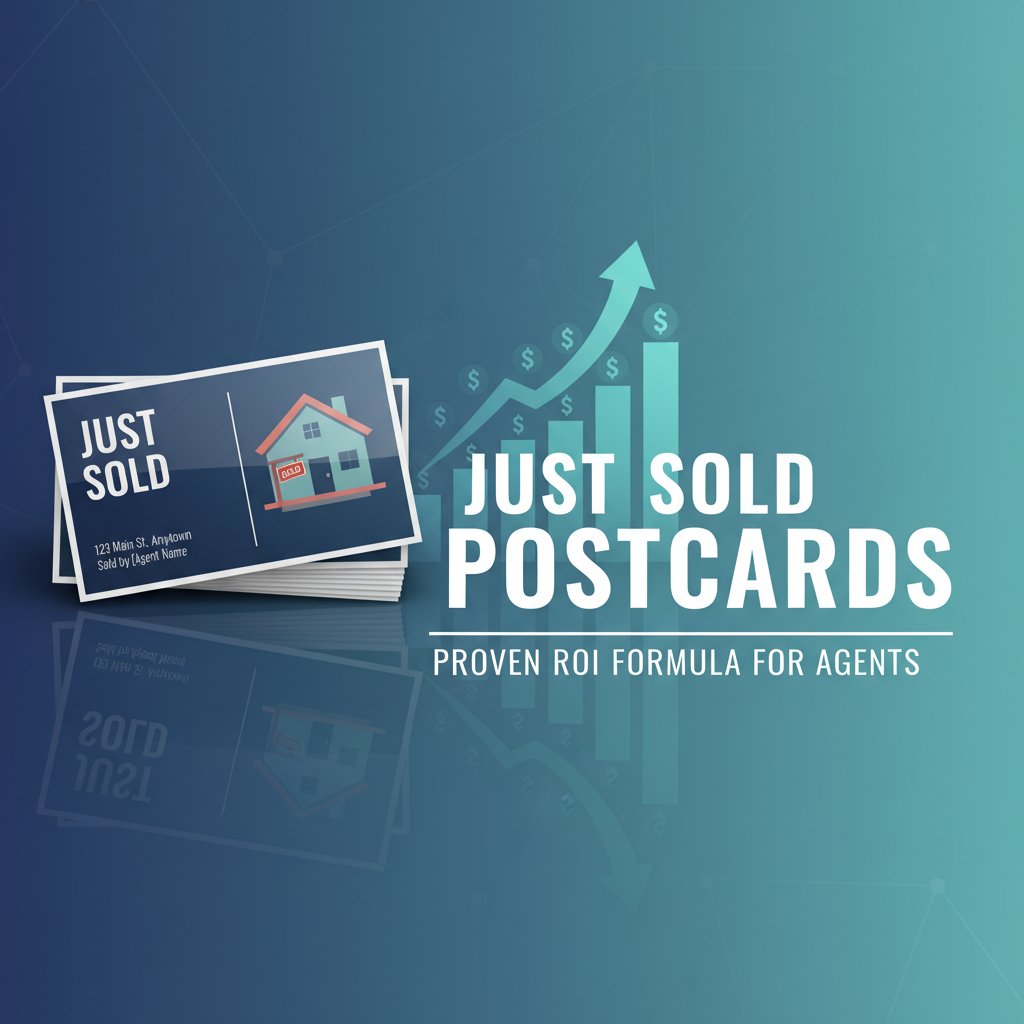
A single just sold postcard mailed to 500 homes can generate three to five listing appointments for an average agent—at a cost of roughly $250 to $350 including design, printing, postage, and mailing. That’s a cost-per-lead of $50 to $117, a fraction of what paid search or social ads typically deliver in competitive real estate markets. Yet most agents send one card, see modest results, and give up. The agents who win with just sold postcards understand the formula: consistency, geographic focus, and a message that proves competence rather than bragging about a sale.
Just sold postcards remain one of the highest-ROI tools in real estate marketing because they deliver social proof at the exact moment neighbors are thinking about their own home values. When done right, these real estate postcards turn closed transactions into predictable listing pipelines. Here’s the proven formula that top-producing agents use in 2026.
Why Just Sold Postcards Outperform Most Digital Lead Gen
Direct mail cuts through the noise. The average consumer receives 121 emails per day and scrolls past dozens of social ads, but only 10 to 15 pieces of physical mail arrive daily. A well-designed postcard sits on the kitchen counter, gets passed to a spouse, and often stays visible for days. In real estate, where listing decisions unfold over weeks or months, that staying power matters.
Just sold postcards work because they answer the question every homeowner asks: “What’s my house worth?” When a neighbor sees your sold postcard with a property photo, address, and sale price, they immediately benchmark their own home. If the market is hot, they wonder if they should sell. If inventory is low, they realize their home might command a premium. Either way, you’re the agent who closed the deal—and the logical choice for a listing consultation.
Response rates for just sold postcards typically range from 0.5% to 2% for cold neighborhoods. For ongoing real estate farming campaigns where the same 500 to 1,000 homes receive your postcards every 30 to 45 days, response rates climb to 3% or higher as recognition builds. The ROI math is straightforward: if you mail 500 homes at $0.60 per piece ($300 total) and generate two listing appointments, you need to close just one to earn a $12,000 to $18,000 commission that pays for a year of farming.
The Four-Part Just Sold Postcard Formula
1. Mail the Right Geography
Your just sold postcard should blanket the neighborhood where you closed the sale—typically a 500- to 1,000-home radius around the property. Use USPS Every Door Direct Mail (EDDM) if you want to saturate an entire carrier route without buying a mailing list, or purchase a targeted list by zip code, subdivision, or home value range if you want more control.
EDDM works well for just sold campaigns because it delivers to every residential address on a route at approximately $0.20 to $0.25 per piece in postage (plus printing and design). Standard postcard sizes for EDDM include 6.25″ × 9″, 6.5″ × 11″, or 6.5″ × 12″. Larger sizes stand out in the mailbox but cost slightly more to print.
If you closed a home in a high-value neighborhood or a hot subdivision, prioritize those addresses. Homeowners in similar price ranges are your best prospects. If you’re farming a specific area long-term, every just sold postcard reinforces your presence and proves you’re the neighborhood expert.
2. Lead with the Sale, Not Your Headshot
The front of your postcard should feature a high-quality photo of the sold property, the address, and the sale price (if local norms and regulations allow). Neighbors want to see the house, not a giant photo of you. Your branding—headshot, logo, contact info—belongs on the back or in a small corner of the front.
Headline options that work:
- “Just Sold: 1234 Maple Street – $525,000”
- “Another Happy Family Finds Their Dream Home on Maple Street”
- “Sold in 9 Days: How We Helped the Johnsons Get Top Dollar”
Include a brief success metric—days on market, percentage over asking, number of offers—that demonstrates your skill. Avoid generic hype like “We’re #1!” or “Call the best!” Social proof beats self-promotion every time.
3. Add a Clear Call-to-Action
Your postcard should tell recipients exactly what to do next. Effective CTAs for just sold postcards include:
- “Curious what your home is worth? Text HOME to [number] for a free market analysis.”
- “Scan the QR code for an instant home value estimate.”
- “Thinking of selling? Call [number] for a no-obligation consultation.”
- “Visit [unique URL] to see recent sales in your neighborhood.”
QR codes have become table stakes in 2026. They allow recipients to instantly access landing pages, valuation tools, or contact forms without typing a URL. Make sure the landing page is mobile-optimized and delivers immediate value—an automated home estimate, a neighborhood market report, or a calendar link to book a call.
If you’re running multiple farming campaigns, use call-tracking numbers or unique URLs for each postcard so you can measure response by neighborhood and refine your targeting over time.
4. Mail Consistently, Not Once
One postcard won’t build a farming territory. The agents who dominate neighborhoods mail every 30 to 60 days for at least six to nine months. Just sold postcards should be one piece in a rotation that includes just listed cards, market updates, seasonal tips, and community spotlights.
Here’s a sample six-month farming calendar for a 500-home neighborhood:
- Month 1: Just sold postcard
- Month 2: Just listed postcard (if applicable) or market update
- Month 3: Spring home maintenance tips
- Month 4: Another just sold postcard
- Month 5: Neighborhood event sponsorship or local business spotlight
- Month 6: Mid-year market report
Consistency breeds familiarity. By the third or fourth mailing, homeowners recognize your name. By the sixth, you’re the agent they think of when they’re ready to sell. The initial just sold postcard opens the door; the follow-up campaign keeps it open.
Real-World ROI Example
Let’s say you’re an agent in a suburban market where the average home sells for $450,000 and you earn a 3% commission ($13,500 per transaction). You just closed a home and want to farm the surrounding 600 homes.
Campaign cost:
- Design: $0 if using a template service or $150 for custom design
- Printing: $0.30 per postcard × 600 = $180
- Postage (EDDM): $0.22 per piece × 600 = $132
- Mailing service: $0.05 per piece × 600 = $30
- Total: $342 to $492
Expected response: At a 1% response rate, you’ll generate six inquiries. If you convert one-third of those into listing appointments, that’s two appointments. Close one listing, and you’ve earned $13,500 on a $342 to $492 investment—a 27x to 39x return.
Even if your response rate is lower or your close rate is modest, the math works. And if you mail that same 600-home list every six weeks for a year, your brand recognition—and response rates—compound.
Common Mistakes That Kill Just Sold Postcard ROI
Mailing Too Broad or Too Narrow
If you mail 5,000 homes once, you’ll spend $2,500 to $3,000 and generate weak recognition. If you mail only 100 homes, you won’t reach critical mass. The sweet spot for most agents is 500 to 1,000 homes mailed repeatedly.
Generic Design and Messaging
Stock templates with clip art and vague headlines get ignored. Invest in professional design that features the actual property, local landmarks, and neighborhood-specific language. Personalization wins.
No Follow-Up
A just sold postcard is an introduction, not a closer. If someone scans your QR code or visits your landing page, follow up within 24 hours with a phone call or personalized email. Speed matters in real estate lead response.
Ignoring Tracking
If you can’t measure it, you can’t improve it. Use unique phone numbers, URLs, or promo codes on each postcard campaign so you know which neighborhoods and messages generate the best response. Most full-service direct mail providers, including Shop Direct Mail, offer list acquisition, design, printing, and mailing in one streamlined package—making tracking easier and reducing the coordination burden on busy agents.
Pairing Just Sold Postcards with Digital
Direct mail and digital marketing aren’t competitors—they’re complements. When a recipient scans your QR code, retarget them with Facebook or Google ads reinforcing your just sold message. Use the postcard to drive traffic to a landing page where you capture emails for drip campaigns. Send a follow-up text or ringless voicemail to the same mailing list a week after the postcards land.
This multi-touch approach increases response rates and keeps you top-of-mind across channels. In a crowded market, the agent who shows up in the mailbox, the inbox, and the social feed is the one who wins the listing.
Frequently Asked Questions
How much do just sold postcards cost per piece?
All-in costs typically range from $0.50 to $0.75 per postcard, including design, printing, postage, and mailing services. EDDM campaigns can run as low as $0.40 to $0.50 per piece for large quantities. Custom designs and premium finishes add to the cost but often improve response rates.
What response rate should I expect from a just sold postcard?
Cold neighborhoods typically generate 0.5% to 2% response rates. Warm farming areas where you’ve mailed consistently for months often see 3% or higher. Response rates improve with repetition, strong calls-to-action, and localized messaging.
Can I mail just sold postcards using EDDM?
Yes. EDDM is ideal for saturating the carrier routes around your sold property without purchasing a mailing list. You’ll reach every residential address on the route at a lower postage rate, typically $0.20 to $0.25 per piece. Standard EDDM postcard sizes include 6.25″ × 9″ and 6.5″ × 11″.
How often should I mail just sold postcards to the same neighborhood?
For ongoing real estate farming, mail every 30 to 60 days. A just sold postcard should be part of a rotation that includes just listed cards, market updates, and seasonal content. Consistency over six to nine months builds recognition and trust.
Do I need to include the sale price on the postcard?
Including the sale price is recommended if local norms and MLS rules allow it. Neighbors want to benchmark their own home values, and transparency builds credibility. If you’re in a market where prices aren’t disclosed, emphasize days on market or other success metrics instead.
How do I track ROI on just sold postcard campaigns?
Use call-tracking phone numbers, unique URLs, QR codes, or promo codes on each postcard. Monitor landing page traffic, form submissions, and inbound calls. Many agents also ask every new lead, “How did you hear about me?” during the first conversation to attribute sources accurately.
Ready to Turn Closings into Listings?
Just sold postcards deliver predictable ROI when you follow the formula: mail the right geography, lead with the property, add a clear call-to-action, and mail consistently. Whether you’re farming a single neighborhood or building a territory across multiple zip codes, real estate postcards keep your name in front of homeowners when they’re ready to sell.
Shop Direct Mail offers full-service real estate postcard campaigns—from strategy and design to list acquisition, printing, and mailing. Explore our real estate postcard templates and turn your next closing into a pipeline of listings.